
Should I Retire Yet? The Emotional Readiness Checklist Most Women Skip
Last Updated: August 9, 2026
Your decision to retire isn't only a financial one. You can have the money handled and still not feel ready. These are the five questions about the emotional side of it, so you can get a clearer read on where you stand.
You've run the numbers and they work. On paper, you could retire tomorrow.
But you're still not totally convinced and keep asking the same question: should I retire yet?
You might be wondering whether you'll lose relevance, whether your world will get smaller, whether you'll be lonely, and what on earth your days will feel like without a job organizing them. This is actually a good thing—it means you're thinking about a very important part of retirement: what your life is going to feel like.
For three years I'd been waiting for my financial advisor to tell me I could afford to retire. He finally said it in May of 2024, on a Zoom call. I was at my desk in my home study and my husband was on the couch, both of us with notebooks open, writing everything down.
He told me I could retire the following year. I'd been waiting a long while to hear that, and when I finally got the good news, instead of feeling ecstatic, I suddenly felt scared.
I don't know if your brain works like mine, but mine went off to the races. What if I regret this and want to be rehired? What if I'm bored out of my mind? What if the first year is fun and then my brain starts to atrophy?
The fear boiled down to this: I could clearly picture ending my career but I couldn't picture the life on the other side of it.
So I gave myself a few months before deciding. I journaled about what my time could look like and what I wanted my life to hold. I had my answer by August, told my boss as soon as the academic year started in September, and retired the following June.
When I looked online for something to help me think through the identity piece and the structure piece, I found plenty about money but almost nothing about the rest of it. So I built these five questions, for women standing on that same ledge.
The five questions:
☐ Can I start to describe who I'm becoming, and not only what I'm leaving?
☐ Can I start to picture what an ordinary week would look like?
☐ Can I start to imagine how I want to contribute?
☐ Can I let myself have mixed feelings without assuming something's wrong?
☐ Am I willing to try something before I decide?
There's no passing score, and you don't have to finish this list before you're allowed to retire. Starting to answer these questions is what matters.
If you're new here: I'm Elaine. I help professional women figure out who they are after their careers end, and what they actually want their lives to look like. Not the financial side. The identity, rhythm, and life side. If retirement is somewhere on your horizon, my free email series is the place to start:
A week of short, guided reflections for women who are financially ready but still can't quite picture the life. One lands each morning, and by Friday you'll know what you want this next chapter to hold.
What the Money Question Leaves Out
Financial readiness tells you whether you can afford to go. But it doesn't address things like how you will find a daily sense of meaning or accomplishment, how you will maintain social connection, or how you'll structure your time to give your week a shape.
A Canadian study followed 748 retirees, most of them women, and found that planning for both the money and the life side leads to a more satisfying retirement than planning the money alone.
While nearly 70 percent had done the financial planning, fewer than half had planned for the life.
We spend decades planning the money, which matters up to a point. We spend almost no time planning the life, which turns out to be what decides how good this feels.
What Readiness Actually Means
Psychologists who study readiness for change have found two things worth knowing before you answer a single question below.
First, wanting something and dreading it at the same time is not a sign you aren't ready. In the stages-of-change model, that exact mix is the defining feature of contemplation, the stage where most people sit before they commit. I sat there for the whole summer of 2024.
Second, readiness has two parts that move separately. How much you want the change, and how sure you feel that you can handle it.
Some women know they want to retire but aren't confident they can handle what comes next. Others aren't sure they want to retire at all. Either way, the best strategy to feel more capable of handling a big change is to try something new and see firsthand that you managed.
You've had the conversation with your financial advisor. Maybe you've mentioned to a couple of friends that you're thinking about retiring next spring. Every time one of them asks how you're feeling about it, you say good, and then you feel something underneath the good that you can't name.
The spreadsheet says go. Something else says wait.
This is what I believe most strongly about the whole transition, and it's where I part ways with most retirement advice: clarity comes from experimenting, not from thinking harder. That's why these five questions end with an experiment instead of a verdict.
The Five Questions
☐ 1. Can I start to describe who I'm becoming, and not only what I'm leaving?
When you've been known for your role for decades, it's natural to wonder what happens when the title drops away.
Try these:
● If someone met me two years into retirement, what would I hope they'd notice about me?
● When I picture introducing myself without my job title, how does that feel?
Right before I retired, my answer sounded something like this: I'm going to help my father in his remaining years and do a variety of things to feed my brain, body, and soul: writing, painting, exercising, socializing, and becoming a coach to support women through their transition into retirement.
Roles, relationships, and things you will do, specific enough that you could picture a whole day made out of them.
Underneath it all, we want to matter and we want to feel needed. I think it's important to figure out that piece of the puzzle while also giving yourself permission to pursue interests that might have been shelved away a long time ago.
☐ 2. Can I start to picture what an ordinary week would look like?
Work gave your days their scaffolding: meetings, deadlines, people counting on you. Without that structure, freedom can feel disorienting.
Ask yourself:
● What would get me out of the house regularly, and who would I see and what would I do?
● What would give my week its shape?
You don't need a packed calendar. You do need enough structure to feel grounded.
I'll admit my own version of this. My last day was June 30, 2025, and in preparation for July 1, I caught myself filling my calendar out of fear rather than interest because I couldn't stand the idea of waking up to a wide-open day with nothing in it. Filling the space is one thing. Designing it so you get to the end of a day feeling like it was worth something is another.
☐ 3. Can I start to imagine how I want to contribute?
This is where fear tends to show up most clearly. With no title, how am I contributing to anything?
Very few of the women who come to me want another career. They do want to matter to someone or something. For some that looks like mentoring younger professionals, for others light volunteer work, taking care of grandchildren, helping a family member who needs it, or shaping the political landscape in ways that feel meaningful to them.
Ask yourself:
● What do I love doing?
● Who benefits from my experience?
● What kind of contribution energizes me rather than drains me?
But I do want to offer a cautionary note. We have been conditioned for decades to contribute. And while that's a good thing, it often comes at a cost to women. We end up not knowing how to give back to ourselves. We feel guilty if we want to spend an afternoon reading a book or doing something creative because we think we "should" be doing something that helps someone.
Something I see often in my coaching work: women arrive convinced they need to find one big thing, and they discover that one or two smaller things give them all the purpose and meaning they were looking for. I think choosing small is a powerful move rather than a lesser one. It's finally your time to enjoy yourself, and keeping some grand project from taking over your life again is you putting yourself first, possibly for the first time in decades.
Got partway down that list and went blank?
That blank spot is worth 45 minutes with someone whose only job is to help you fill it in. A Retirement Clarity Session is $97, and you leave with one concrete next step in writing.
☐ 4. Can I let myself have mixed feelings without assuming something's wrong?
Retirement brings relief, grief, excitement, and apprehension, sometimes in the same afternoon.
You might be thinking, "If I were really ready, I'd feel confident." Confidence isn't the thing you have before you start. It shows up once you begin practicing, and you can start practicing well before your last day.
You know exactly what your life looks like with a job in it. Of course the version without one feels less solid.
One way to read your own signals is to listen to what you've been saying all year, not just about the job but about what the job has been crowding out. For me it had nothing to do with disliking my work. I started resenting that every morning I had to stop reading, stop journaling, stop learning about whatever I'd gotten curious about, because the workday was starting. That resentment was the information.
For some women it's the job. For others the job is fine and there's no room left for anything else. Both are answers.
Then there's the question I ask clients most often: does this job still fit the life you want? Not the life you had when you took it. The one you want now.
☐ 5. Am I willing to try something before I decide?
You don't have to quit your job to learn something real about your readiness.
Everything above is reflection, and reflection has a ceiling. At some point you learn more from twenty minutes of doing than from another six months of considering, and the doing is what builds the confidence you've been waiting to feel.
An experiment can be very small. Sit in on a meeting of a group you might want to join. Take a Friday off and spend it the way you imagine spending a retired weekday, then notice how it felt.
None of that commits you to anything, and all of it tells you something a spreadsheet can't. Best of all, you can do it now, while you still have a paycheck and nothing on the line.
Waiting for Something to Rescue You
A lot of women are waiting for a few solid things lined up before they decide, something to count on when the structure disappears. That is a completely reasonable thing to want.
Think back to high school for a second. You'd lost interest in your boyfriend, and you didn't break up with him because at least you had a date for prom. The thing had run its course and you knew it, and you still didn't want to be standing there with nothing. (The job is the boyfriend.)
The trouble with waiting for something else to come your way is that it may not arrive. More often, deciding is what sets it in motion.
It's scary to say out loud that you're retiring when you can't see what life looks like on the other side. So picture standing at the edge of a river. To feel okay about crossing, it helps to see a few stepping stones first.
A stepping stone is one small plan or decision. For me it was deciding to get certified as a coach while I was still working as a professor. For one client it was booking a trip that started the week after her last day. For another, it was joining a nonprofit board in her community.
That client came to me while she was still working and unsure whether it was time. She treated the board seat as an experiment rather than a commitment, and she learned more from it than from months of turning the question over. Six months later she had a date, she'd told her boss, and she had two more stepping stones lined up. Here is how she described the change:
“You’ve really helped me to get from point A to point B. Point A was: oh my god, I really think I have to retire but I am so scared. Can I pull the trigger? And point B is: it’s going to be okay. I still don’t have everything all figured out, but I have more confidence that I’ll be able to do that.”
One stepping stone is enough to start. I'd rather you find one now than wait until the whole path is visible, because the years you spend waiting for certainty are years you could spend finding out what else you enjoy.
Try This: Name One Possible Stepping Stone
You don't have to commit to anything today. Start by naming one thing you'd like your retired life to include. A board, a class, a trip, a certification, or a month with nothing on the calendar at all, which counts every bit as much as the ambitious ones.
Then take one small step toward finding out more. Look up what it involves, talk it over with your partner or a friend, make one call.
You're not deciding anything. You're finding out whether the thing you've been imagining is real and available to you, and that's most of what makes the other side of the river look less blank.
What Happens After You Decide
Women ask me how long it takes to feel settled after retiring. First comes relief and freedom. Then a dip, as the novelty wears off and the loss of structure and identity registers. Then a slower reorientation, as you work out what you want this chapter to hold.
The part that usually gets left out is that the dip is temporary. Satisfaction comes back up, and women who feel unmoored a year in are almost never unmoored at year four.
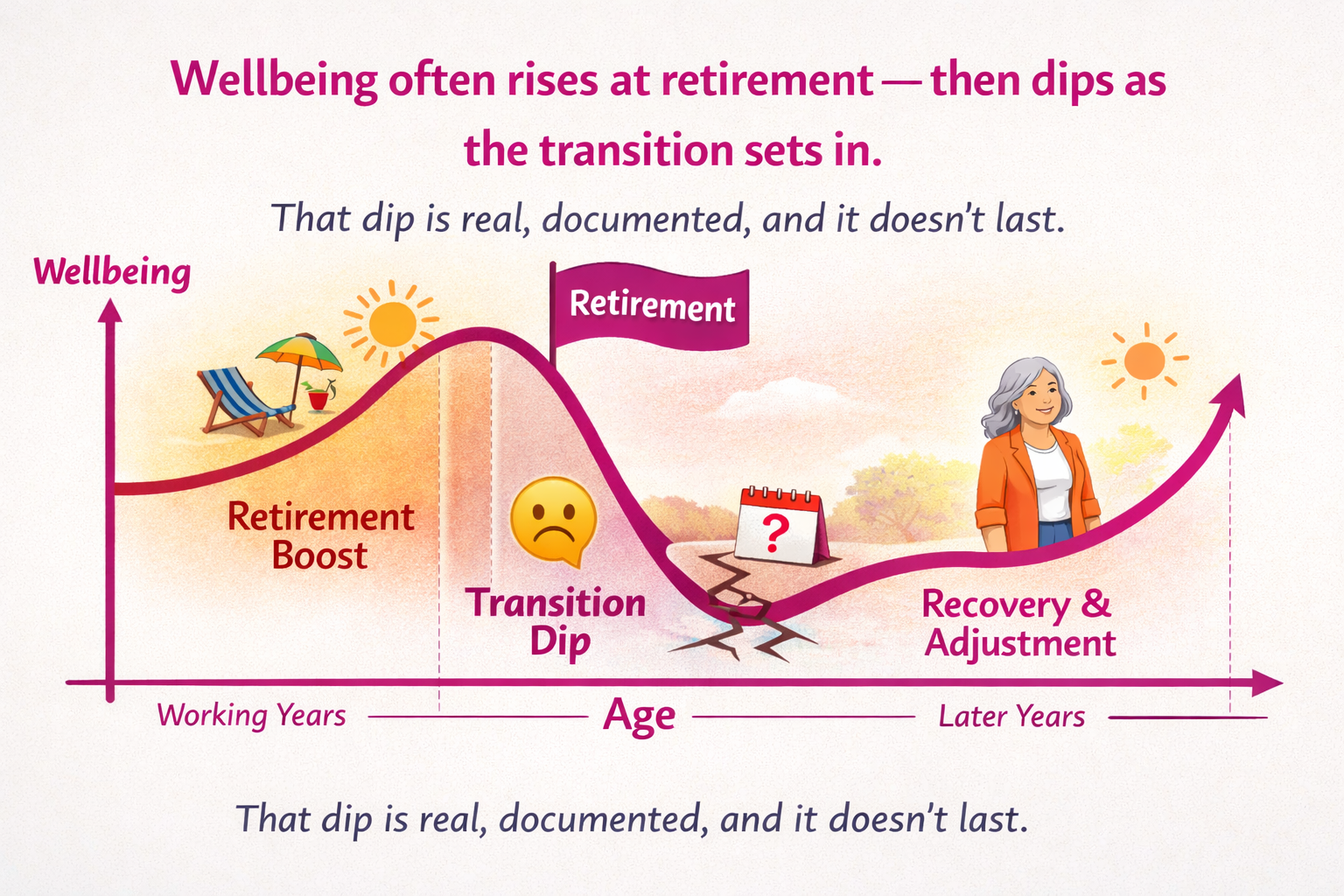
What seems to shorten the dip is having some of the life side already built when you walk out. Just enough that the first months hold something besides open time. A stepping stone or two, a standing commitment, people you'll see on purpose.
A First Step
A lot of this comes down to learning to trust yourself again, and to believing you're worth building a life around now.
And if you've just finished the week of Retiring Into Yourself and you're sitting with a page of your own answers, wondering what on earth they add up to, that's the most common place to land. Noticing what you want is the easier part. Working out what to do about it, and holding onto it once regular life comes roaring back, is where most thoughtful women lose momentum.
You've been carrying this by yourself for months, and it doesn't settle on its own.
“Elaine helped me uncover insights that probably would have taken me months, if ever, to work out on my own. She asked thoughtful, incisive questions that opened me up, and before I knew it we were talking deeply about what I was experiencing as a newly retired person. Her guidance helped me reconnect with my creativity, increase self-awareness, and feel more engaged in my post-working life. Elaine is warm, smart, intuitive, and incredibly knowledgeable.”
That's the part I can help with. A Retirement Clarity Session is 45 minutes on Zoom, $97, to say all of it out loud to someone who has no stake in what you decide. My job is to help you sort through what's swirling around in there and see what your own answers are pointing toward.
A few days beforehand you fill out a short reflection, about fifteen minutes, based on Martin Seligman's research into what makes a life feel good. That alone shows you where your life feels full right now and where it feels thin.
Afterward I send you written notes with your key insights and one concrete next step. Your first stepping stone. Women tell me they pull those notes back up weeks later, on the nights the doubt comes back.
Plenty of women book one session, take that step, and go do the rest on their own. That's a good outcome and I'm glad when it happens.
Frequently Asked Questions
-
You're starting to be able to describe who you're becoming, picture what an ordinary week holds, name how you want to contribute, and sit with mixed feelings without reading them as a warning sign. Certainty and excitement are not requirements. Plenty of women who are completely ready feel apprehensive the week before their last day.
-
Yes, and it makes sense when you look at what a job hands you: the shape it gives your week, a reason to get up, people who know your name, the steady feeling of being good at something.
You never had to plan for any of that, and all of it stops on the same day. Some women stay anxious about the money too, even after being told they have enough, because spending down savings they spent decades building feels wrong. Neither means you've planned badly or that you shouldn't retire.
-
Loving your work and being ready to leave it are not in conflict. I was fully engaged right up to my last day and still knew it was time to go. The better question is whether the job fits the life you want now, and then the one most women can't answer yet: where is all that energy going to go?
-
That worry about not being able to go back keeps a lot of capable women waiting. What I've found is that regret usually traces back to an empty calendar rather than to leaving too soon.
-
Longer than most women expect, and the hardest stretch usually arrives after the early freedom wears off rather than in the first weeks. The research describes the arc but never a reliable timeframe, so be careful with anyone who gives you one.
-
No. You need enough of a picture that the open time feels like possibility: what gives your week its shape, where you'll find people, and one or two things you want to try.
Share This With a Friend
Know a woman who's been turning a retirement date over for a year without picking one? These are the five questions her financial advisor won't ask. Use the share buttons to send it her way.
Sources
Prochaska, J. O., & DiClemente, C. C. (1983). Stages and processes of self-change of smoking: Toward an integrative model of change. Journal of Consulting and Clinical Psychology, 51(3), 390–395. https://doi.org/10.1037/0022-006X.51.3.390
Bandura, A. (1977). Self-efficacy: Toward a unifying theory of behavioral change. Psychological Review, 84(2), 191–215. https://doi.org/10.1037/0033-295X.84.2.191
Hutchinson, S. L., & Ausman, C. (2024). Lifestyle planning in the transition to retirement. Journal of Aging Research and Lifestyle.https://doi.org/10.14283/jarlife.2024.4
Atchley, R. C. (1976).The Sociology of Retirement. Schenkman. And Atchley, R. C. (1999).Continuity and Adaptation in Aging. Johns Hopkins University Press.
Pinquart, M., & Schindler, I. (2007). Changes of life satisfaction in the transition to retirement: A latent-class approach. Psychology and Aging, 22(3), 442–455.
Wang, M. (2007). Profiling retirees in the retirement transition and adjustment process. Journal of Applied Psychology, 92(2), 455–474.
About Elaine
Elaine Belansky, PhD, is a retirement transition coach who helps thoughtful, accomplished women design a next chapter that feels intentional, meaningful, and fully their own.
After a 30-year university career in public health and education, Elaine retired in June 2025. She now supports women facing the identity shifts, emotional complexity, and loss of structure that often accompany retirement. Drawing on psychological research and her own experience, she guides clients through a structured process to clarify who they are becoming, design a weekly rhythm that supports energy and engagement, and choose ways to contribute that feel purposeful, not obligatory.
Her work helps women move from feeling unmoored or uncertain to feeling grounded, energized, and confident about the life they're building now.
