What Is Retirement Coaching — and Could It Be Right for You?
Updated May 2026
“I thought I’d feel better than this.”
It’s one of the most common things I hear — from women who have just retired, and from women who are standing at the edge of it, trying to decide whether to jump.
For some, the calendar has already cleared — the emails stopped, the title disappeared — and instead of the relief they expected, something else showed up. A low-grade unease they can’t quite name. Not depression. Not crisis. Just a persistent sense that this chapter isn’t fitting the way they thought it would.
For others, retirement is still ahead — and the closer it gets, the more a question is getting louder: Who am I without all of this?
Both experiences are completely normal. And both make sense — because for most of your career, work gave you structure, identity, and community, all at once. When it disappears, the discomfort isn’t a character flaw. It’s the predictable result of losing three things you didn’t even know you were relying on. That’s what retirement coaching is for.
So What Is Retirement Coaching — and What Isn’t It?
Here’s what it is — and what it isn’t.
Retirement coaching is not financial advising. I’m not going to talk to you about your 401(k), your Roth IRA, or when to take Social Security (or your pension, ISA, and State Pension if you’re in the UK). That’s your financial planner’s job, and I hope you have a good one.
It’s also not therapy — though coaching and therapy can work beautifully together. Therapy helps you understand the experiences that shaped you — the wounds you’ve carried, the coping strategies you developed, the stories you’ve been telling yourself for decades. Coaching helps you figure out where you want to go — and then actually build the life that gets you there.
So what is coaching? A structured, highly personalized process — grounded in real conversation — that helps you figure out who you are in this chapter and build a life that feels 100% yours. We work on the questions your financial spreadsheet can’t answer: Who am I without the title I held for 30 years? How do I build a life with shape and rhythm without turning it into another job? What do I actually want — not what I’m supposed to want, but what genuinely lights me up?
Who Is This For?
It’s for women who handled everything — the career, the family, the aging parents, the impossible deadlines. Women who are self-aware enough to know something is off — and too proud to say it out loud. Women who googled “why do I feel so lost after retiring” or “how do I know when I’m ready to retire” at midnight and felt their chest tighten a little.
What matters isn’t your job title — it’s how much of yourself you poured into your roles. Whether your identity was built around a career, raising a family, caregiving for aging parents, or all of the above, when those roles fall away — sometimes all at once — this transition hits differently than people expect.
You don’t need to be in crisis to benefit from this work. You just need to be honest with yourself that what you have right now isn’t quite what you want — and that you’re ready to do something about it.
Nancy Kagan spent decades building and running her own company. Six months before she retired, she started asking the questions most women wait until after retirement to face: Who am I without my title? What will actually make me happy? Watch her share what that process was like — and where she is now.
The Bold Retirement Method
As my own retirement date got closer, the anxiety crept in. I looked online for guidance — how to psychologically prepare, how to actually be happy in retirement — and I couldn’t find anything designed for smart, professional women like me. So I built the Bold Retirement Method.
It’s a 12-session, six-month coaching program — research-informed and highly tailored to you — designed so that by the end, you have a clear sense of what you’re moving toward and the confidence to actually build it. Before each session, I send you a packet of exercises to help you reconnect with your values, your energy, and what you actually want — so you walk in having already started to hear your own voice.
Here’s how the four phases unfold:
Phase 1: Build Your Foundation (Sessions 1–3)
We clarify your core values, take an honest look at where you are across different areas of your life — including your health and energy — and explore the parts of your professional identity you want to carry forward. We also surface interests and intellectual curiosities that may have been deferred during high-demand years.
What often shifts: You feel steadier, clearer, and more at home in yourself.
Phase 2: Craft Your Vision (Sessions 4–6)
From that steadier place, you can finally look up. We explore what your ideal retirement actually looks like — your ideal day, your sense of purpose and contribution, your appetite for joy and curiosity, and the deeper questions of legacy and meaning. And we tackle the fears that are quietly running the show — fear of loneliness, fear of irrelevance, fear that this chapter won’t be enough. We don’t sidestep those. We work through them.
What often shifts: The future feels less abstract and a lot more exciting. Direction begins to emerge.
Phase 3: Build Your Roadmap (Sessions 7–10)
You know what matters. Now we make it real. We identify your key focus areas, set meaningful goals, and design daily and weekly rhythms that give your life shape without turning retirement into another job. We also build the social connections that research consistently shows matter most for wellbeing in this chapter.
What often shifts: Time feels intentional again. Days have shape without feeling rigid.
Phase 4: Embark on the Journey (Sessions 11–12)
This is where insight turns into lived experience. You begin taking the steps you’ve designed — tracking what’s working, adjusting what isn’t, and building the flexibility to evolve as your life shifts. Because retirement isn’t a destination you arrive at. It’s something you keep designing.
What often shifts: You trust yourself again — so that when retirement throws something unexpected at you, and it will, you know how to respond and keep going.
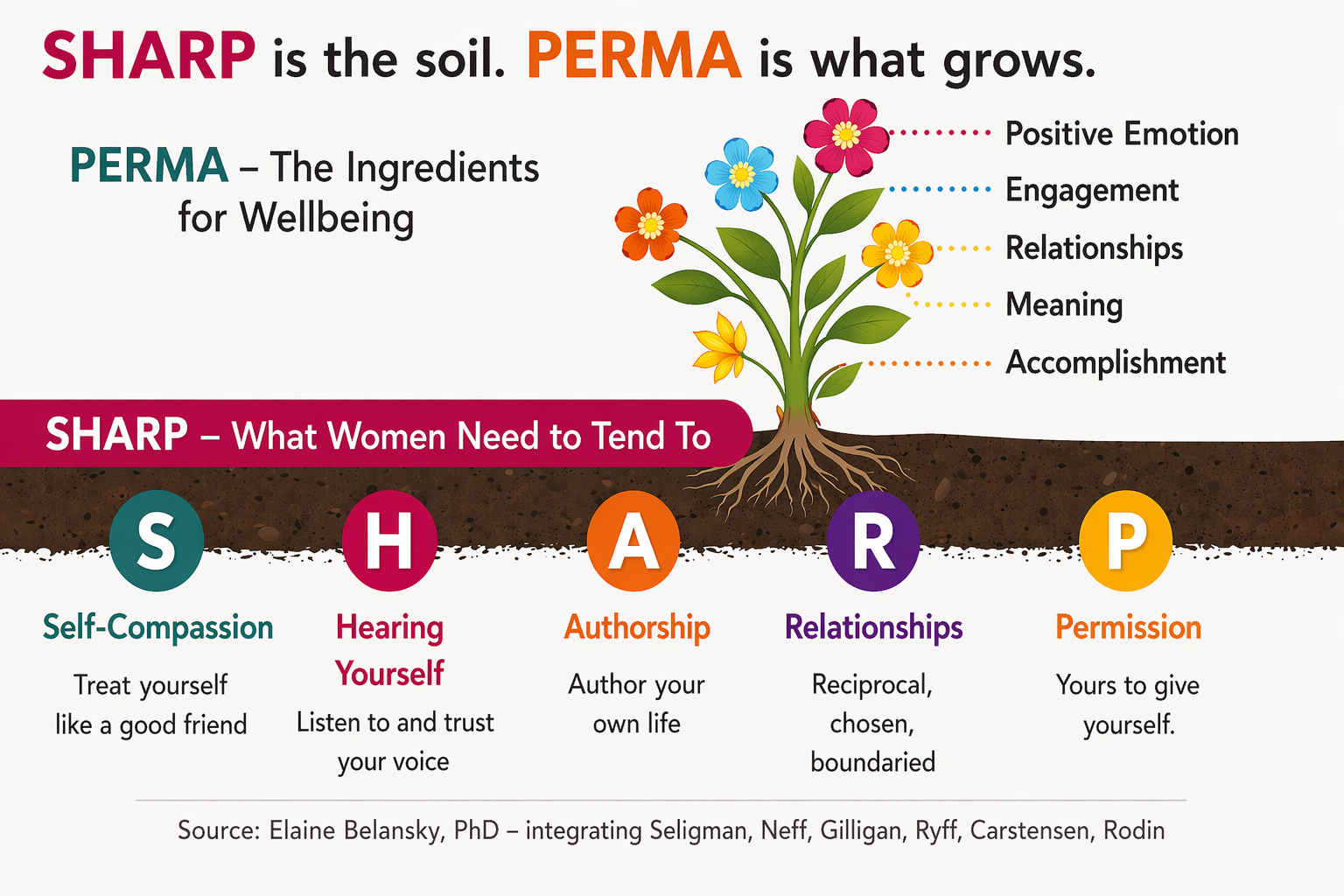
The entire program is grounded in two frameworks: SHARP, which identifies what women in this transition need to tend to (Self-Compassion, Hearing Yourself, Authorship, Relationships, and Permission), and PERMA, the positive psychology model that tells us what a life that feels good is actually made of. Together, they're the backbone of everything we do.
By the end, you have a life that has shape, direction, and feels like yours.
“I am loving it way more than I thought. I have given myself permission to embrace all the new things I get to do and all the new things I get to try.”
— Nancy K., Retired Business Owner
What Working with Me Feels Like — and What Changes
I want to be honest with you: I’m not a coach who has this all figured out and is now graciously passing wisdom down from the mountaintop. I retired in 2025, and I’m navigating this same transition alongside my clients. I still have mornings where I feel slightly disoriented. So when you bring something hard into our sessions — the grief of leaving a career you loved, the guilt of finally putting yourself first, the strange loneliness of a Tuesday with nowhere to be — I’m not meeting you from a distance. I know that terrain.
Here’s what I see change: You come in worried your world is about to shrink — worried people will ask more of you without work as a buffer, worried you’ll lose the sharp, capable version of yourself you’ve spent decades building, sitting with bigger questions like should I move, should I even retire yet. By the end, something has shifted. You’re braver — willing to try things you’d been putting off, willing to prioritize yourself in a way that used to feel selfish. You trust yourself more. And that sense of clarity and forward motion is what makes this chapter feel not like an ending, but like something you’ve genuinely been waiting for.
Ready to Take One Step?
If you've found yourself nodding while reading this — or feeling that low-grade recognition that this chapter isn't quite what you hoped — that's worth paying attention to. You don’t have to be in crisis to reach out. You just have to be willing to have an honest conversation about where you are and what you want next.
The Retirement Clarity Session is a single 45-minute conversation — just the two of us on Zoom — where we focus entirely on you. What’s feeling stuck, what’s feeling possible, and what one grounded next step looks like from where you are right now.
Here’s what Nancy H., a retired professor, said after hers:
“Elaine helped me uncover insights that probably would have taken me months, if ever, to work out on my own. She asked thoughtful, incisive questions that opened me up, and before I knew it we were talking deeply about what I was experiencing as a newly retired person. Her guidance helped me reconnect with my creativity, increase self-awareness, and feel more engaged in my post-working life.”
— Nancy H., Retired Professor
One powerful conversation. $97.
If you're already sensing this is bigger than one conversation, the Bold Retirement Method might be exactly what you need. Schedule a free 30-minute consult to learn more.
Frequently Asked Questions
Is retirement coaching only for people who are really struggling?
Not at all. Some of the women I work with are genuinely in a hard place — and this work can help with that. Others are doing well by most measures but sense that this chapter could be more than it currently is. You don’t need to be at a breaking point to deserve support. You just need to be ready for a conversation.
What if I haven’t retired yet — or haven’t even decided if I’m going to?
You’re in exactly the right place. Coaching is valuable at every stage — whether you’re years away and the questions are getting louder, actively deciding whether to retire, or approaching your last day and wanting to step into it with intention. Research shows that people who plan for the life side of retirement fare significantly better in their first year than those who only plan the finances. Starting early isn’t jumping the gun. It’s smart preparation.
What if I’m not sure I’m ready for coaching?
That uncertainty is more common than you’d think. Most women who reach out aren’t completely sure they’re ready — they’re just tired enough of the current feeling to be willing to have a conversation. A Retirement Clarity Session is a good place to start.
How is the Bold Retirement Method different from other coaching programs?
It's built specifically for this transition and goes deeper than most, addressing the full picture: not just the identity shift, but also the joy, the curiosity, the rediscovery of parts of yourself you set aside years ago. Every session agenda is built from what you share in your pre-session packet — we’re always working on what’s actually alive for you. And it’s grounded in real psychology and behavioral science, not just inspiration.
The program is built around SHARP — a framework I developed that addresses what professional women specifically need to tend to in this transition: Self-Compassion, Hearing Yourself, Authorship, Relationships, and Permission. SHARP is the soil. PERMA — the positive emotion, engagement, meaning, and accomplishment that make a life feel good — is what grows from it.
How long does the program take?
Designed as six months with sessions roughly every two weeks — but in practice it often takes a little longer, and that’s completely fine. The pace is yours.
Can I do coaching if I’m already working with a therapist?
Absolutely — many of my clients do both. Therapy focuses on processing and healing; coaching focuses on designing and building forward. We simply set clear lanes, and those boundaries make both relationships more effective, not less.
One Last Thing
You’ve spent a long time being really good at something. Showing up, delivering, being the person others could count on. That doesn’t disappear when you retire. It just needs somewhere new to go.
This chapter is yours to design. Not your employer’s version of you, not your family’s version of you — yours. And if part of you already knows this isn't quite the life you want — that knowing is worth listening to.
You don’t have to figure this out alone, and you don’t have to figure it all out at once. You just have to take one honest step.
Here’s to your bold new chapter — I’d love to be part of it.
Elaine
If this post resonated with you, chances are you know another woman navigating this same chapter. Send it her way — it might be exactly what she needs right now.
About Elaine
Elaine Belansky, PhD, is a retirement transition coach who helps thoughtful, accomplished women design a next chapter that feels intentional, meaningful, and fully their own.
After a 30-year university career in public health and education, Elaine now supports women navigating the identity shifts, emotional complexity, and loss of structure that often accompany retirement. Drawing on psychological research and lived experience, she guides clients through a structured process to clarify who they are becoming, design a weekly rhythm that supports energy and engagement, and choose ways to contribute that feel purposeful — not obligatory.
Her work helps women move from feeling unmoored and uncertain to feeling grounded, energized, and genuinely excited about the life they’re building.
She is also a regular contributor to Sixty and Me, where she writes about the emotional and identity shifts women face in retirement.
Learn more about Elaine