
What Will I Do All Day? (And Other Retirement Fears No One Talks About)
This is the second in a short series about what I’m learning as I approach my June 30 retirement.
I used to imagine retirement as endless Saturday mornings — slow starts, quiet coffee, and lots and lots of what I jokingly call “Elaine Time.”
I coined that phrase years ago when I realized how much I craved a sliver of the morning to myself before diving into work. I’d wake up early — sometimes before 6 a.m. — just to read, meditate, journal, or work on a novel. That time made me feel grounded and like myself.
So when I pictured retirement, I assumed Elaine Time would simply expand.
But then a question crept in.
If Elaine Time takes three hours… maybe four if I really stretch it out…
what happens after that?
What will I do at 11 a.m?
At 1 p.m?
At 4 p.m — day after day?
That’s the part that quietly scared me.
If you’re new here:
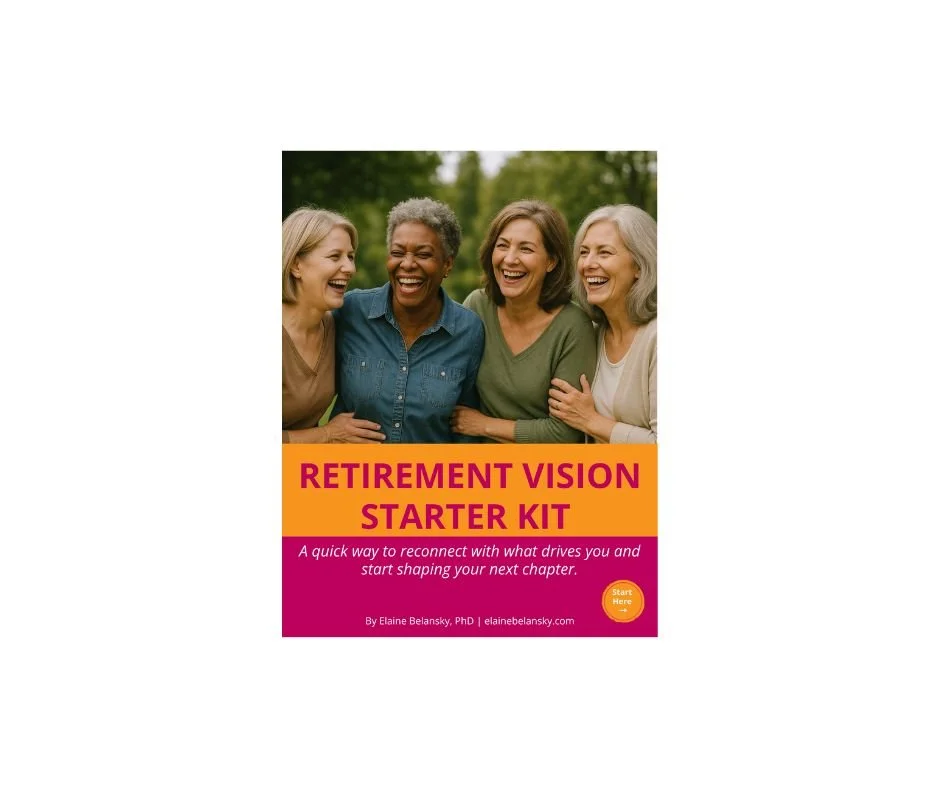
Click here for the Free Starter Kit
Get clear on what you want your next chapter to look like—without pressure to have it all figured out.
Start with my free Retirement Vision Starter Kit — a quick, research-informed way to get clarity on what you want your next chapter to look like. It takes about 20 minutes.
The Empty Calendar Moment
Like many professional women, I’ve spent decades in motion — leading, producing, caregiving, mentoring, fixing. My identity has been shaped by a full calendar and a clear rhythm. I knew where I was needed and when.
Then one day, it hit me: soon, I’ll be deleting all my recurring meetings.
Once those are gone, my calendar will be… empty.
At first, that sounds like freedom.
But then the questions rush in.
What will I do with all that open time?
Will I miss the casual connection of coworkers?
How do I create structure without slipping into rigidity?
And how do I make sure my days still feel purposeful — not just pleasant?
It felt a little like being handed a blank canvas… and realizing I wasn’t entirely sure what I wanted to paint.
A Small Moment That Shifted Something
Last weekend, my husband and I were at the farmer’s market buying seedlings. I struck up a conversation with a farmer selling cucumber plants and — in classic Elaine fashion — overshared that I was retiring soon and had always fantasized about working on a farm. I quickly added that my bad back probably made that unrealistic.
He paused, smiled, and said,
“You know, you could still volunteer. We always need help cleaning seeds. That wouldn’t bother your back.”
Then he invited me to come out on a volunteer day.
I have no idea what “cleaning seeds” actually means — but I said yes.
That small exchange stuck with me. Not because it solved anything, but because it reminded me of something important:
You don’t have to live the entire dream to feel the heart of it.
Sometimes one small experiment is enough.
This is something I see again and again when I’m coaching with clients:
clarity doesn’t come from thinking harder. It comes from trying something — and noticing how it feels.
My Very Unofficial Retirement Plan
For the past two years, I’ve kept a note on my phone called “Elaine’s Retirement.” It’s not a traditional plan. It’s more like a living list — a way to explore how I want my days and weeks to feel.
I’ve grouped ideas into loose categories:
Spiritual. Creative. Physical. Learning. Nature. Social. Volunteering. Travel. Home.
Some ideas are big:
Walk the Camino de Santiago
Finish the novel I’m writing about reinvention
Host a women’s retreat
Others are small and deeply human:
Make jam
Be a NICU cuddler
Build a little free library for my neighborhood
And some reflect the values I want woven into my everyday life:
Volunteer with immigrant families
Read to children in low-income schools
Learn more about astronomy and world history
This kind of planning may look informal — but it turns out it matters. Research consistently shows that people who think about the life side of retirement — not just the financial side — feel more settled and satisfied over time.
Not because they have everything figured out.
But because they begin engaging with life instead of waiting for clarity to arrive.
Try This: What Comes After Your Me Time?
You don’t need a five-year plan.
And you don’t need to decide what the rest of your life will look like.
A Simple Starting Point
Name 3–5 things you genuinely enjoy during uninterrupted “me time.”
Ask yourself: If a day had that same energy, what else might fit?
Start a simple “Life List” with categories like Creativity, Connection, Movement, Learning, Nature, Service, or Just-for-Fun.
Add anything that sparks curiosity — even if it feels impractical or half-formed.
This isn’t a bucket list.
It’s a compass.
Want Help Shaping What Comes Next?
If the idea of an open calendar feels exciting and unsettling, you’re not alone.
I created a free Retirement Vision Starter Kit to help women begin shaping this next chapter with intention — without pressure to have it all figured out.
Inside, you’ll find prompts to help you:
Clarify how you want to feel in this phase of life
Identify what you want more (and less) of in your days
Explore where a bit of structure could bring ease and direction
You can complete it right on your computer or print it out and work through it old-school — whatever feels best to you.
Retirement isn’t the end of your story.
It’s the beginning of a chapter you get to design — one small, real-life experiment at a time.
Share this with a friend:
If you know a woman who’s financially ready to retire—but still feels unsure about the life part—use the share buttons below to send this post to her.
About Elaine
Elaine Belansky, PhD, is a retirement transition coach who helps thoughtful, accomplished women design a next chapter that feels intentional, meaningful, and fully their own.
After a 30-year university career in public health and education, Elaine now supports women navigating the identity shifts, emotional complexity, and loss of structure that often accompany retirement. Drawing on psychological research and lived experience, she guides clients through a structured process to clarify who they are becoming, design a weekly rhythm that supports energy and engagement, and choose ways to contribute that feel purposeful — not obligatory.
Her work helps women move from feeling unmoored or uncertain to feeling grounded, energized, and confident about the life they’re building now.
