
Your best years aren’t behind you — they’re waiting to be designed. Here’s how one research-backed framework can help you build a retirement that feels full, grounded, and alive.
She called herself a “workhorse.”
Thirty years of showing up, delivering, leading. And then — suddenly — she wasn’t doing any of that anymore. When she described her days to me, she used the word “failing.” She meant it literally. ‘I am failing at retirement.’
She wasn’t failing. She was grieving. And she had no map for what came next.
She’d assumed, the way most of us do, that once the hard part was over — the career, the deadlines, the juggling — the rest would sort itself out. It hadn’t. And she couldn’t figure out why.
She’s not unusual. What if it’s not enough? What if this is all there is? I’ve heard some version of those questions from many of the women I work with — that creeping fear that retirement isn’t delivering the way they expected. The thing they planned for, worked toward, looked forward to. And now that they’re here, something feels missing and they can’t quite name it.
That feeling isn’t a character flaw or a failure of gratitude. It has a name. I call it PERMA deprivation — and once you understand it, everything starts to make sense.
If you’re new here:
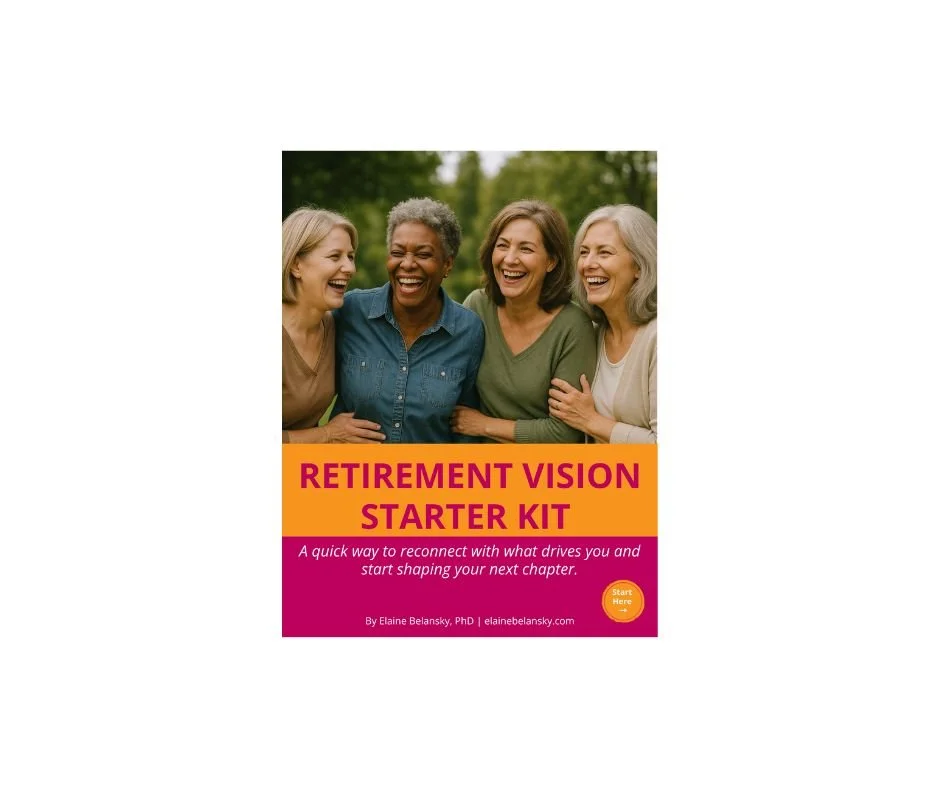
Free Starter Kit
Get clear on what you want your next chapter to look like—without pressure to have it all figured out.
Start with my free Retirement Vision Starter Kit — a short guided reflection that helps you clarify what you want your next chapter to look like and identify the parts of life that need attention right now.
If the identity piece feels like the hardest part, you might also like the Who Am I Now? Guide — five psychology-grounded reflections for women in transition.
What Is PERMA, Really?
PERMA comes from psychologist Dr. Martin Seligman, one of the founders of positive psychology. It identifies five ingredients that consistently show up in people who feel vibrant and grounded:
P — Positive Emotion: The ability to feel joy, gratitude, and contentment — not just relief that you survived the week.
E — Engagement: Getting lost in what you love doing. That delicious flow state where time disappears and you’re completely absorbed.
R — Relationships: Feeling genuinely connected and valued by people who matter to you.
M — Meaning: Knowing your life stands for something. That your days add up to more than tasks crossed off a list.
A — Accomplishment: The confidence and genuine pride that come from growth, learning, and progress.
Think of PERMA as a recipe for well-being. You don’t need every ingredient in perfect balance — but when one goes missing, life starts to lose flavor. And here’s what’s tricky about retirement: in a single transition, you can lose all five at once.
This is why “just stay busy” doesn’t work — not really. Staying busy can actually be a way of abandoning yourself. You leave behind your comfort with stillness. You leave behind the desires, interests, and curiosities that need to be nurtured. And you leave behind the most important question: What is it that I truly want to experience in this phase of my life? PERMA gives you a way to answer it.
Why Retirement Hits So Hard (Even When You’re “Fine”)
When your structure disappears, you can lose engagement.
When your role disappears, you can lose meaning.
When your colleagues disappear, you can lose connection.
When your achievements stop being measured, you can lose a sense of accomplishment.
And when all of that happens simultaneously — positive emotion tends to go underground too.
The woman I mentioned at the beginning lost all of this in one fell swoop. Thirty years of structure, purpose, colleagues, and daily proof that she mattered — gone in a single transition she thought she was ready for. No one told her that retirement could crack your sense of self like that. Nobody hands you a guide.
Big transitions are hard. And most of us are far harder on ourselves than we’d ever be on a friend going through the same thing. This transition deserves more than a calendar full of activities and a hope that things will sort themselves out.
I Use PERMA Myself — Here’s What That Looks Like
I first discovered PERMA about five years ago when I was directing a center focused on promoting health and wellbeing for rural educators and students — and it became our north star for that work.
These days, now that I’m retired, I think about it all the time. It’s not a framework I trot out for clients and then set aside. It actually guides how I plan my weeks:
P: I structure my mornings to feel grounded — journaling first thing, planning a day that will actually feed my soul. And when I close my eyes at night, I run through what I’m grateful for.
Small ritual, real impact.
E: I carve out time for the art projects I keep buying supplies for. (The pile is getting embarrassing.)
R: I make real plans — not just proximity — with my husband, my two daughters, and friends. There’s a difference between being near people and actually connecting with them.
M: I support the women I work with in designing their next chapter. That work fills me up in a way almost nothing else does.
A: I try to close all three exercise rings on my watch every week. (My watch remains skeptical. Hope springs eternal.)
PERMA also forms the foundation of my Bold Retirement Method — the coaching framework I developed to help women move from feeling “off” or uncertain to designing a chapter that feels alive, connected, and deeply fulfilling.
How to Make PERMA Part of Your Life
PERMA isn’t abstract once you get it into your actual days. Here’s what each element might look like in yours.
P — Positive Emotion
Start smaller than you think you need to. Savor your morning coffee without your phone nearby. Notice the quality of light on your kitchen counter. Send a thank-you text to someone who’s been on your mind — or go old school and send a handwritten note. Gratitude isn’t just feel-good advice — it’s medicine. It trains your brain to register what’s already good while you’re building what’s next.
E — Engagement
Do something that makes time disappear. Gardening, watercolor, writing, volunteering for a cause you care about, learning a language, taking a ceramics class — whatever absorbs you completely. Flow isn’t a luxury. For high-achieving women especially, it’s a physiological need. Your nervous system knows the difference between being busy and being engaged.
R — Relationships
Curate your circle, and be intentional about it. Choose people who bring energy rather than drain it. And here’s something nobody tells you: new friendships after retirement often appear where genuine curiosity lives — a class, a hiking group, a committee, a volunteer project. You don’t need to force it. You need to show up in places that interest you.
M — Meaning
Ask yourself: where can I make a difference now, in this season of my life? Sometimes meaning comes from mentoring a younger woman, serving on a board, tending a community garden, or sharing expertise you once took for granted. It doesn’t have to be enormous. It has to be real.
A — Accomplishment
Keep learning something. Keep growing somewhere. When I retired after 30 years as a social psychologist, I took a huge leap and became a certified life coach. I had to learn everything from scratch — how to coach, how to build a website, how to write articles like this one. It was humbling, scary, and absolutely exhilarating. Accomplishment in retirement is about the feeling of aliveness that comes from doing something hard and doing it anyway.
What Realignment Actually Looks Like
I want to tell you about one of my clients — I’ll call her Barbara. On paper, she was doing everything right. Still active in causes she cared deeply about. Still connected. Plenty to do.
But she was exhausted in a way she couldn’t quite explain, and she was judging herself for it.
What came out as we worked together was more complicated than it first appeared. Barbara genuinely loved her environmental work — it mattered deeply to her and she was good at it. But when we started pulling on the thread of why she was doing it, two very different answers emerged. One was real: she cared about the planet, and that work was part of who she was. The other was harder to admit: she needed her family to see her as someone doing something of value. She worried that if she slowed down, stepped back, or — heaven forbid — spent an afternoon doing something purely for joy, people would think she’d checked out. She didn’t want to become one of those people who “just plays pickleball.”
The creative projects she’d always wanted to pursue? Squeezed to the edges. The things that would have genuinely filled her up? Waiting.
Her shift wasn’t about doing less. It was about asking a more honest question: Am I doing this because I want to, or because I’m afraid of what it means if I don’t?
That distinction — from “I should” to “I choose” — changed how everything felt. Not overnight. But steadily.
That’s PERMA in action. Not reinvention. Realignment. And it almost always starts with giving yourself permission to want what you actually want.
The PERMA Check-In
Here’s a simple way to put this to use right now. Take five minutes — literally five — and do this:
If you’re curious where you stand right now, here’s a simple five-minute check-in.
For each letter of PERMA, write one sentence:
“Right now, this element feels _______ in my life.”
Then ask: which one feels most alive? Which one feels most depleted?
You don’t have to fix anything today. You just have to know which one needs attention. That awareness is where the design begins.
Want a simple place to start? The Retirement Vision Starter Kit walks you through a short reflection that helps you see where your life currently stands — and where you want more energy, connection, meaning, or growth. It takes about 20 minutes, and many women tell me it’s the first time retirement has started to feel clearer.
When Reflection Isn’t Enough
Most women can get a lot of mileage from articles like this one and tools like the Starter Kit. The reflection matters. The framework helps.
But sometimes you’re ready for more than reflection. You’ve been thinking about this for a while. You know something is off, but you can’t quite see it clearly on your own. Or you see it clearly, but you’re not moving.
This is especially common for high-capability women who are used to being competent at everything — and who don’t know what to do with a problem they can’t just figure their way out of.
If that’s where you are, that’s exactly what my Retirement Clarity Session is designed for — a 45-minute private Zoom conversation that takes all this thinking and turns it into one grounded, specific next step.
And if you’re ready to go deeper — to actually design the structure, rhythm, and purpose of your next chapter — you can learn more about the Bold Retirement Method here.
Bringing It All Together
PERMA isn’t theory. It’s a map.
When you build your days around what actually helps you flourish — joy, genuine engagement, real connection, meaning, growth — life starts to hum again.
You stop filling your time and start fulfilling your life.
Retirement isn’t the end of your story. It’s the first chapter you’ve ever gotten to write entirely on your own terms.
If you want a simple place to start, the Retirement Vision Starter Kit is here.
Related posts to keep exploring:
• Why Open Days in Retirement Feel Hard — and What Actually Helps (The Identity Shift)
• The Secret to Finding Purpose in Retirement? Start Smaller Than You Think (Purpose Without Pressure)
• What Is Retirement Coaching — and Could It Be Right for You? (Retirement Lifestyle Planning)
Share this with a friend
If you know a woman who’s been asking herself what if this is all there is? — send this her way. She might be more PERMA-deprived than she realizes.
About Elaine
Elaine Belansky, PhD, is a retirement transition coach who helps thoughtful, accomplished women design a next chapter that feels intentional, meaningful, and fully their own.
After a 30-year university career in public health and education, Elaine now supports women navigating the identity shifts, emotional complexity, and loss of structure that often accompany retirement. Drawing on psychological research and lived experience, she guides clients through a structured process to clarify who they are becoming, design a weekly rhythm that supports energy and engagement, and choose ways to contribute that feel purposeful — not obligatory.
Her work helps women move from feeling unmoored and uncertain to feeling grounded, energized, and genuinely excited about the life they’re building.
She is also a regular contributor to Sixty and Me, where she writes about the emotional and identity shifts women face in retirement.
Learn more at elainebelansky.com
Adapted from an article originally published on Sixty and Me.
