
Why Retirement Feels Harder for High-Achieving Women (And What Actually Helps)
For nearly twenty years, I was the queen.
Not literally of course. I directed a small but mighty research center at a university, with an annual operating budget of a million dollars. I raised funds, set the vision, networked, hired, mentored, and made sure the whole operation honored our mission: supporting rural schools from low-income communities. My associate director of ten years had a system for our weekly meetings — he would draw a small crown next to anything he wanted to raise with me, so he could quickly see which topics to bring up. The queen would weigh in.
I’m laughing as I write this, because it sounds absurd. But it also felt really good. People scheduled things around my availability. When I walked into a room, I had credibility before I said a word. The center was often called “Elaine’s center” — not its actual name. My ego was well-fed.
And then I retired.
What surprised me most was how easy it was to walk away from the role itself. Nearly two decades of relationships, programs, partnerships — and I basically haven’t looked back. What I didn’t anticipate was the loss of being known. Being sought after. Feeling good about myself when I had an answer to, “So, what do you do?”
If you’re new here:
For a broader look at what you want your next chapter to look like, the Retirement Vision Starter Kit is a good place to begin.
Why High-Achieving Women Are Caught Off Guard
Both personally and as a retirement transition coach, what I’ve observed is this: women who built their identities around professional achievement often find retirement disorienting in ways they didn’t anticipate. And that’s not a coincidence.
Think about who we were for all those years. Many of us could wake up early, make sure the kids were fed and loved, work productively and efficiently, come home and do it all over again — and then tackle a work task after dinner. We mastered high performance and multi-tasking. We brought home the bacon and fried it up in the pan. (You know the commercial.) If we were lucky, we derived tremendous meaning and accomplishment from what we did. We were recognized. Respected. Sought after.
That’s exactly what makes retirement so destabilizing.
When the career ends, it doesn’t just take the job. It takes the structure that organized our days, the feedback loop that told us we were doing well, the social connection we didn’t have to manufacture, and the identity we’d spent decades building. For many of us, we knew we existed — in the most visceral sense — because of the respect and recognition we received. But on the flip side, we may not have spent much time cultivating an inner world, because there simply wasn’t room.
And yet, the advice available to women navigating retirement rarely addresses any of this directly. Most resources focus on finances, travel, or finding new hobbies. The specific psychological experience of leaving behind a professional identity — that part often goes unnamed. Which is part of why so many accomplished women find themselves caught off guard.
What We Actually Lose
When we retire, we lose our title and the status that came with it. We lose the daily feedback — literal or otherwise — that confirmed we had something valuable to offer. We lose our connection to our fields, to technology, to the latest trends and ideas in our profession. We lose a ready-made social world of people who knew us, cared about us, and shared our professional DNA.
One of my clients, a longtime executive who retired after decades of leadership, described it this way: she missed being recognized as an expert and being sought after as an advisor. She talked about how energizing it had felt to give presentations — the room listening, the applause afterward. She wondered, out loud, whether she’d ever feel that way again.
I also lost something I didn’t expect: I stopped laughing as freely. I realized this when I had a dream about my former associate director — the one with the crown system. In the dream, we were sitting together laughing uproariously, the way we used to in our best moments. When I woke up, it hit me: I don’t have that kind of easy, organic laughter in my days anymore. Not because my life is sad — quite the contrary — but because I’m no longer surrounded by people who share a history with me, who catch the reference, who appreciate the joke. That kind of laughter is one of the hidden casualties of leaving work behind.
We also lose our excuses. For years, “I’m so busy at work” justified not cultivating our inner world, not experimenting with who we were outside of our roles, not setting limits with friends and family. Retirement removes that cover. Suddenly we’re face to face with questions we’ve never had to answer.
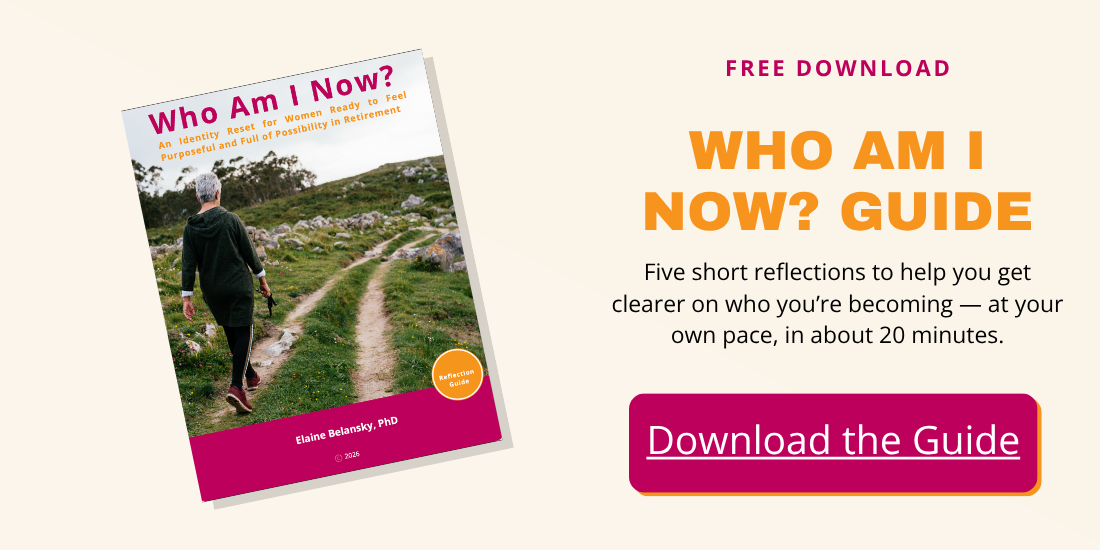
Sitting with “Who am I now?” is the right question. The Who Am I Now? Guide gives you five short reflections to start finding your answer — about 20 minutes, at your own pace.
The Question Nobody Prepared You For
Who am I now?
Not who were you. Not what did you accomplish. Who are you now — when the title is gone, the calendar is open, and no one is waiting for your sage advice?
Most high-achieving women have never seriously contemplated this question. Our identities were shaped around achievement, contribution, and external validation. We knew ourselves through what we did and how well we did it. That worked beautifully for decades. It just doesn’t translate cleanly to retirement.
This is the heart of what makes retirement harder for women like us. It’s not a character flaw. It’s almost a predictable outcome of how we were wired to succeed.
What Becomes Possible When the Professional Role Loosens Its Grip
The loss is real, and thankfully, something else is possible.
When the professional identity loosens its grip, space opens up. Not immediately, and not without some fumbling — but it opens. I’ve watched it happen with clients, and I’ve lived it myself.
One of my clients, a recently retired professor, realized that her outer world was full and good — meaningful relationships, a comfortable home, a community she cared about — but her inner world had been neglected for years. The one thing she really wanted in retirement was to write. Once she named that, she created a simple daily practice: early morning walks in a forest near her house, phone left behind. Just space to hear herself think. That’s where her writing began.
Another client had no clear sense of how she grounded herself each day. When I asked her, she paused and thought about it. She reached out to friends by text each morning, but beyond that she was drawing a blank. Retirement was finally giving her slower mornings to start exploring what a real inner practice might look like.
I’m in this exploration myself. I’ve tried plenty of things in my first eight months — some clicked, some didn’t, and all of it was useful information. After my dad died, I started showing up consistently at Friday night services at my synagogue. And something began to happen there — a slow version of the Cheers “Norm!” moment, where people recognize me, call me by name, and I feel like I belong to something. It reminds me of what I loved most about work: being part of a community, being known, mattering to a group of people who show up week after week. That’s belonging.
This is what I think of as the second adolescence of retirement. We have time, space, and some freedom to try things and see what fits. Not every experiment works. That’s entirely the point.
Two Things That Actually Help
The first is developing a daily practice of checking in with yourself. Not a productivity ritual — a self ritual. It might be journaling, a morning walk, prayer, meditation, or simply sitting with a cup of coffee and asking: What’s going on in my heart and mind today? How do I want to feel? What do I need to be aware of? For women who spent decades being highly attuned to everyone else’s needs, this practice is often surprisingly hard. And surprisingly clarifying.
The second is adopting an experimenter’s mindset. Start trying things — even small things — and pay attention to what gives you energy and what drains it. Cross things off the list that don’t feel like a match. Stay curious rather than judgmental. I’ve seen women begin this process before they even retire, and it makes an enormous difference. Clarity almost always comes from action, not from thinking harder.
Try This: The “What I Actually Miss” Check
Grab a piece of paper (or open a notes app) and write down your answers to these three questions:
• What specifically do I miss from my working life? (Be concrete — the presentations, the problem-solving, the laughter in the hallway, being recognized by name.)
• What need was that filling? (Status, belonging, competence, contribution, structure — name it without judgment.)
• Where else in my life, or in what new context, could that need be met?
This isn’t about replacing your career. It’s about understanding what it gave you so you can find it — in different forms — in this chapter. The Cheers “Norm!” moment at my synagogue wasn’t a replacement for my research center. It was a different answer to the same underlying need: to belong somewhere, to be known.
A First Step
If you’re navigating this transition — whether you’ve recently retired, you’re still deciding, or you’re a few years in and still finding your footing — the question “Who am I now?” isn’t a sign that something went wrong. It’s the right question. And it deserves a real answer.
I created a free guide specifically for high-achieving women sitting with exactly this question. It’s called the Who Am I Now? Guide — five short reflections you can move through in about 20 minutes, or sit with more slowly if you want to go deeper.
The guide walks you through naming where you are in this transition, releasing the roles that are ready to be let go, reconnecting with what made you come alive long before your career began, identifying how you want to feel each day as your north star, and capturing a snapshot of who you’re becoming.
→ Download the free Who Am I Now? Guide here.
Be kind to yourself — what you are experiencing is especially common for high-capability women who are used to being competent and suddenly don’t feel that way in this transition. If you’d like support moving through the fog faster, my Retirement Clarity Session is one real conversation —45 minutes, a pre-session form with questions about different aspects of your wellbeing, and one concrete next step you can act on immediately.
Related posts to keep exploring:
I Thought I Knew Who I Was - Until Retirement Made Me Rethink It (The Identity Shift)
Why Open Days in Retirement Feel Hard - And What Actually Helps (Rhythm & Routine)
What is Retirement Coaching - and Could it Be Right for You? (Retirement Lifestyle Planning)
Share this with a friend
Know a woman who’s financially ready to retire but unsure about the life part? Use the share buttons to send this her way.
About Elaine
Elaine Belansky, PhD, is a retirement transition coach who helps thoughtful, accomplished women design a next chapter that feels intentional, meaningful, and fully their own.
After a 30-year university career in public health and education, Elaine now supports women navigating the identity shifts, emotional complexity, and loss of structure that often accompany retirement. Drawing on psychological research and lived experience, she guides clients through a structured process to clarify who they are becoming, design a weekly rhythm that supports energy and engagement, and choose ways to contribute that feel purposeful — not obligatory.
Her work helps women move from feeling unmoored and uncertain to feeling grounded, energized, and genuinely excited about the life they’re building.
She is also a regular contributor to Sixty and Me, where she writes about the emotional and identity shifts women face in retirement.
Learn more at elainebelansky.com/about.
Adapted from an article originally published on Sixty and Me.
