
The Busyness Trap: Why Staying Busy in Retirement Isn’t the Same as Living Well
If you’ve retired and find yourself filling every day — but still feeling a low-grade emptiness you can’t quite name — you’ve probably fallen into the busyness trap. It’s one of the most common patterns I see in retirement, and one of the least talked about.
I have a cart full of art supplies to the right of my desk. To my left, there’s a stool with more supplies precariously balanced on top of it. And front and center on my beautiful mango wood desk: my monitor, keyboard, mouse, and laptop.
That image pretty much sums up my retirement so far.
When I have open time — no coaching sessions, no workshops, no deadlines — I go upstairs to my study and work on my coaching practice. I tell myself it’s necessary. And sometimes it is. But I also know the art projects I’ve been dreaming about, the creative writing I keep meaning to start, the books stacked on my nightstand — those things don’t have the same gravitational pull as a task list. Working on my coaching practice feels productive. Opening a sketchbook feels indulgent. And for women who spent decades earning their worth through output, that distinction is hard to shake.
Last week I finally moved the laptop off the desk to make room for an art project. I had to physically relocate the keyboard, the mouse, all of it. And when I did, it felt — I’m not exaggerating — like I was finally liberating and respecting myself.
Which told me something I needed to hear: the thing I kept calling productivity was actually avoidance.
If you’re new here:
Start with my free Retirement Vision Starter Kit — a research-informed way to get clarity on what you actually want your next chapter to look like.If the identity shift is the hardest part, you may also like the Who Am I Now? Guide.
I was wrapping up a workshop on the emotional side of retirement — 144 women on Zoom, half of them more than two years into this chapter — when I heard it named out loud for the first time.
I’d asked everyone to drop one word into the chat to describe how retirement actually feels. Some women wrote freeing, wonderful, liberating. Others wrote scary, disorienting, now what, free fall. My favorite: “Scary and lovely at the same time.”
Then one woman added, almost as an aside, that she’d been staying very busy — teaching classes, taking classes, filling the calendar — and then wrote: “I think I stay busy to avoid the problem.”
Four other women immediately responded with some version of: same.
That’s the busyness trap. And it’s more common — and more understandable — than most retirement advice acknowledges.
Busyness Feels Like Proof You’re Doing It Right
After a career built on productivity, calendars, and measurable outcomes, a full schedule can feel like evidence that retirement is going well. If you’re busy, you must be enjoying yourself. If you’re busy, you can’t possibly be struggling.
But there’s a problem with that logic, and I see it in coaching sessions regularly: a woman can stay genuinely, relentlessly busy — volunteer commitments, fitness classes, grandchildren, travel — and still feel a low-grade emptiness she can’t quite name.
Busyness and fulfillment are not the same thing. Staying occupied is not the same as living well.
The distinction matters because if you don’t know you’ve fallen into the trap, you can’t find your way out of it.
What Busyness Is Actually Avoiding
The woman in my workshop was more self-aware than most. She knew she was using busyness to sidestep something. But most of us don’t name it that directly — at least not at first.
What is busyness avoiding? In my experience, it’s usually one of a few things.
Sometimes it’s the discomfort of open, unstructured time. Many professional women have spent decades operating under the implicit rule that rest requires justification — that you earn your downtime. A blank calendar, then, doesn’t feel like freedom. It feels like a warning. Like if you stop producing, you might stop mattering.
Sometimes it’s the question that surfaces the moment the noise stops: Who am I now, without the role and the work and the status that came with it? That question is real and it deserves a real answer. But it’s also uncomfortable enough that staying busy can feel like a reasonable alternative — at least for a while.
And sometimes — as I can personally attest — it’s simply that one thing feels justified and the other doesn’t. Working on my coaching practice feels productive. Opening a sketchbook feels indulgent. So I reach for the laptop.
If you’re realizing that busyness isn’t quite filling the cup, the Retirement Vision Starter Kit is a good place to start getting clearer on what would.
The Research Backs This Up
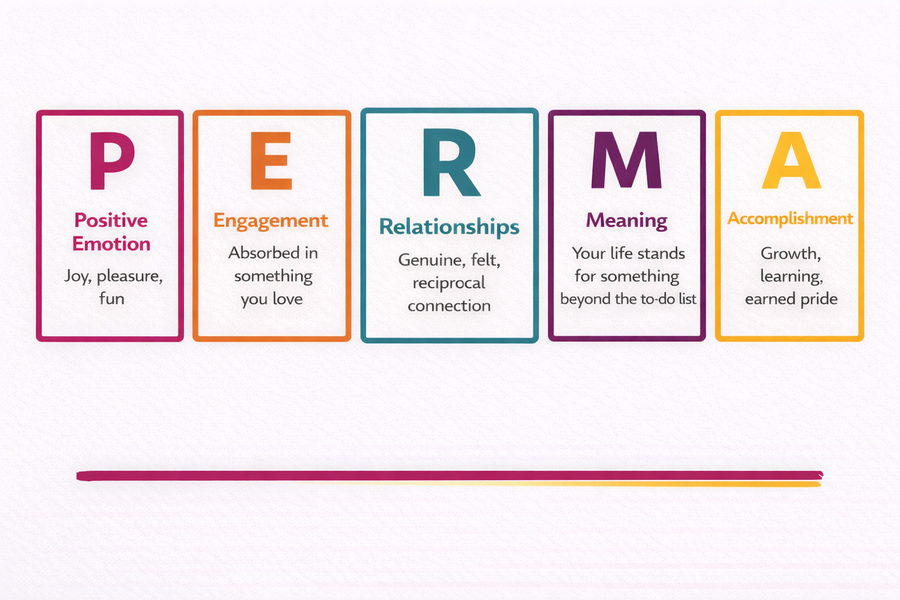
Psychologist Martin Seligman’s PERMA framework identifies five ingredients that research consistently links to wellbeing: Positive Emotion, Engagement, Relationships, Meaning, and Accomplishment.
Here’s what makes retirement uniquely hard: in a single transition, you can lose all five at once.
Your structure disappears — there goes Engagement.
Your role disappears — there goes Meaning.
Your colleagues disappear — there go Relationships.
Your achievements stop being measured — there goes Accomplishment.
And when all of that happens simultaneously, Positive Emotion tends to go underground too.
Busyness can substitute for some of these — it can create a sense of Accomplishment and fill your calendar with other people. But there’s a difference between being around people and actually feeling connected to them. You can have a full social week and still come home feeling a little off, because they weren’t quite your people. And no amount of busyness creates Engagement — the kind where time disappears because you’re absorbed in something — or Meaning, the felt sense that your life stands for something beyond the to-do list.
The Difference Between Filling Time and Designing It
There’s nothing wrong with being busy. Experimentation — trying out volunteer roles, joining groups, testing new routines — is genuinely useful, especially in the first year or two. Some experiments work. Many don’t. That’s how you find what fits.
The problem is when busyness becomes something you do to avoid the blank spaces rather than because it’s actually filling your cup.
A question I often ask clients: If you cleared your schedule for the next two weeks, what would you actually want to do? Not what you think you should do. Not what would look like a good answer. What would you want to do?
For many women, that question is harder to answer than it sounds. After decades of equating busyness with doing life right, the more essential question — what do I actually want? — can feel almost foreign.
Designing your time in retirement means making deliberate choices about what gets on your calendar — and, just as importantly, what doesn’t. It means including a few things you already know will fill you up, not just fill the hours. And it means leaving enough space to actually notice what you’re feeling, what you’re craving, what you might be avoiding.
What It Looks Like to Choose Differently
I’ve been trying to practice what I preach. Not perfectly — the laptop is still winning more days than I’d like — but I’m making small moves.
Recently I joined a Facebook group for women over 60 who are trying to connect. One woman posted asking if anyone was from Colorado. I mentioned my town. Three other women immediately replied — they live in the same town.
So I did something that felt, honestly, a little scary: I asked if they’d like to meet for coffee.
One of them already wrote back. “I’m in! I still work, so it’s weekends for me.”
Here’s the thing about that moment: it felt risky. Meeting strangers is a bit like a blind date — it could be a bust, or it could be the beginning of something. Most of my close friends have either moved away or are still working full-time, and I feel that gap more than I expected to. The art, the writing, the friendships — those are what actually fill my life. Yours will look different. But the only way to get there is to show up for the things you want, even when it feels uncertain.
That’s the shift. From filling time to choosing what you actually want, even when it feels uncertain. The art supplies instead of the laptop. The coffee date instead of another hour in the study. The thing that requires you to begin — without any guarantee that it goes well.
Try This: Your Personal PERMA Audit
This takes about 10 minutes and is more revealing than it sounds. For each of the five PERMA elements, answer two questions honestly: what’s your busyness currently giving you, and what’s it not giving you?
Positive Emotion: Does your current schedule include things that genuinely make you feel good — not just occupied? Or are most activities neutral at best?
Engagement: Is there anything in your week where time disappears because you’re absorbed? If not, what used to do that for you — and is there a version of it available to you now?
Relationships: Are the people in your calendar actually your people — the ones where you come home feeling more alive? Or are most of your social activities filling the hours without filling the tank?
Meaning: Does what you’re spending your time on feel like it matters to you — not what should matter, but what actually does?
Accomplishment: Are you getting a felt sense of progress on things you care about? Or is your sense of accomplishment coming mostly from checking tasks off a list?
Look at your answers. The gaps — the PERMA elements where busyness isn’t delivering — are where to focus. You don’t have to overhaul your calendar. But one intentional addition in a gap area will do more for how you feel than adding three more activities that land in columns you’ve already filled.
A First Step
The goal isn’t to do less. The goal is to choose more intentionally.
That starts with slowing down long enough to ask a few honest questions — not in a grand, dramatic way, just as a practice. What did I do this week that actually energized me? What felt like obligation? What am I putting on my calendar out of habit, and what am I choosing on purpose?
You don’t have to have the answers yet. But the willingness to ask is where it starts.
If you want a structured place to begin, the Retirement Vision Starter Kit walks you through five steps to start imagining what a genuinely fulfilling retirement looks like for you. It’s free and takes about 20 minutes.
→ Download the free Retirement Vision Starter Kit here.
And if you’d like to go deeper — to actually sort through what you want your days to look like and build a plan you can act on — my Retirement Clarity Session is one focused conversation: 45 minutes, a pre-session form with questions about different aspects of your wellbeing, and one concrete next step you leave with.
Related Posts to Keep Exploring
• The Secret to Finding Purpose in Retirement? Start Smaller Than You Think (Purpose Without Pressure)
• Why Open Days in Retirement Feel Hard — and What Actually Helps (Rhythm & Routine)
• What Is Retirement Coaching — and Could It Be Right for You? (Retirement Lifestyle Planning)
Share this with a friend
Know a woman who’s financially ready to retire but unsure about the life part? Use the share buttons to send this her way.
Elaine Belansky, PhD, is a retirement transition coach who helps thoughtful, accomplished women design a next chapter that feels intentional, meaningful, and fully their own.
After a 30-year university career in public health and education, Elaine now supports women navigating the identity shifts, emotional complexity, and loss of structure that often accompany retirement. Drawing on psychological research and lived experience, she guides clients through a structured process to clarify who they are becoming, design a weekly rhythm that supports energy and engagement, and choose ways to contribute that feel purposeful — not obligatory.
Her work helps women move from feeling unmoored and uncertain to feeling grounded, energized, and genuinely excited about the life they’re building.
She is also a regular contributor to Sixty and Me, where she writes about the emotional and identity shifts women face in retirement.
Learn more at elainebelansky.com.
Adapted from an article originally published on Sixty and Me.
