
Why You Miss People From Work You Were Never That Close To
Last Thursday night, I found myself at a hotel bar at 10pm. I was very proud of myself for staying up so late. I know, I know — retirement means I don’t have to get up early. But the truth is, I’m an early-to-bed kind of person.
I was out with my cousin, who was visiting from Boston and is significantly more of a night owl than I am. We’d been to a comedy club. I didn’t want to disappoint her by getting home too early, so I suggested one cocktail at a swanky nearby hotel, and off we went.
When we arrived at the bar, I noticed them immediately: a large group of people from a conference. You could tell because they were still wearing name tags, all from the same organization. Different ages, different backgrounds, all animated and talking over each other in that particular way people do at the end of a conference day — full of ideas, loose from the cocktails, glad to finally be out of the session rooms.
The women had clustered together at one end of the bar. The men were at the other. Everyone was in full networking mode.
I watched them for a moment and felt something I didn’t quite expect.
Not envy, exactly. Not nostalgia. I found myself thinking about all the conferences I used to attend — the nice hotels in fun cities, the cocktail hours I always dreaded walking into, the colleagues from across the country I’d see once or twice a year. And I realized: I don’t miss the conferences. But I do miss what they gave me.
I’ve been sitting with that feeling ever since. And I’ve heard enough versions of it from the women I work with to know it’s not just me.
If you’re new here:
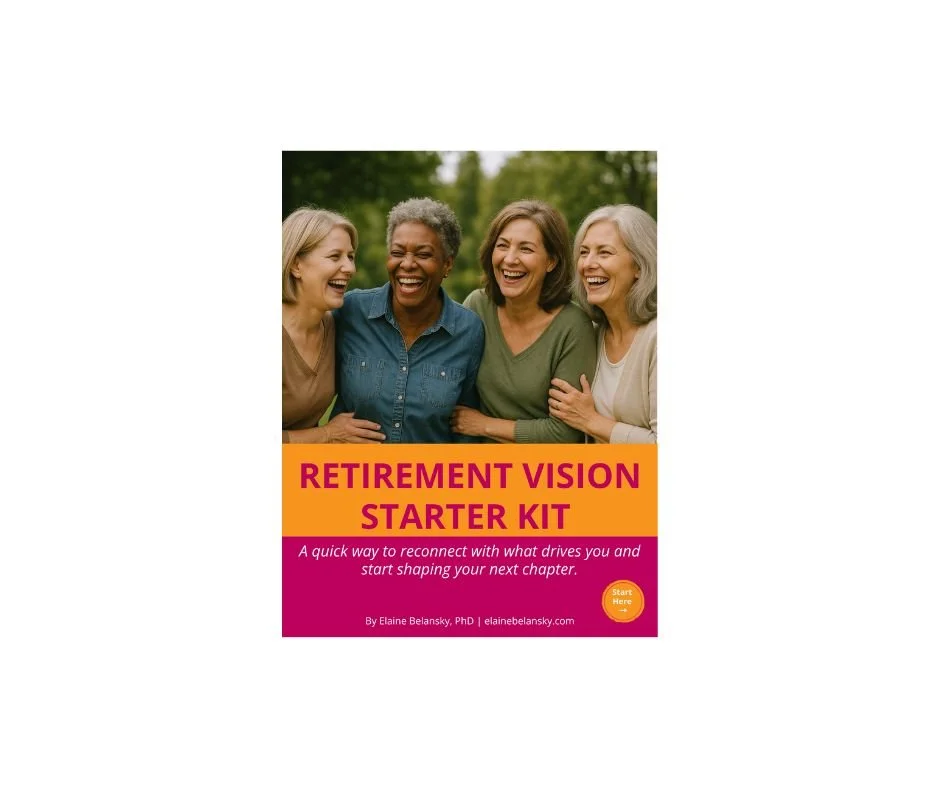
Free Retirement Vision Starter Kit
Get honest about what you want your retirement to feel like — including your relationships and daily joy. Free, 20 minutes.
Start with my free Retirement Vision Starter Kit — a 20-minute, research-informed way to get clarity on what you want your next chapter to look like, including your relationships.
If the identity shift is the hardest part, you may also like the free Who Am I Now? Guide .
The Social Connection That Came With the Job
As a professor, I traveled to conferences regularly. Over the years, I became friendly with colleagues from across the country. We’d catch up on each other’s projects, hear about each other’s families, have dinner and laugh and feel, for a few days, like we were part of something larger.
Back at the college, there were the people I saw daily — teammates and collaborators I’d spent years working alongside. I knew what stage their kids were in. Eventually, what colleges the kids were applying to. I knew who was going through something hard and who had just gotten good news. That daily contact felt genuinely good. The kind of easy, built-in connection that doesn’t require any effort to maintain. It’s just… there.
What I didn’t fully understand until I retired was how many of my daily social needs had been met by my job — the sense of being known, of seeing familiar faces, of having people around who were glad to see me — without me having to seek any of it out.
Looking back now, almost a year into retirement, I can see honestly that I don’t have friendships with most of those people anymore. I enjoyed the relationships while I had them. I liked those people. But the relationships were situational. They existed because we worked together, traveled together, shared a professional context. Like being friendly with a neighbor — warm and real while it lasts, but not something that typically survives a move.
That’s not a criticism of those relationships. It’s just an accurate description of what they were.
Why This Happens — and Why No One Warns You
Repeated contact with the same people tends to create liking — even without deep conversations or shared values. Simply being around the same people regularly — in meetings, in the hallway, at the coffee machine — builds familiarity and warmth over time.
Work supplied this effortlessly. And along with it came something else that’s easy to overlook: the everyday, low-key moments that make you feel like you exist in someone else’s world. The colleague who always says good morning. The team that knows the inside joke. The person who asks how the weekend was and actually remembers what you said. These aren’t deep friendships. But they create a steady sense of being seen. Work provided them for free.
Studies show that retirement itself doesn’t cause loneliness. But it removes the structure that was providing connection — and eventually we figure out which relationships were deep enough to survive outside of work.
For many women, that reckoning hits particularly hard. Relationships aren’t just one part of a fulfilling life — for most of the women I work with, connection is the thing everything else lives inside of. Work gave us daily interaction, recognition, shared history, and a sense of being woven into other people’s lives. When that disappears, the loss can feel surprisingly personal. Not just social. Identity-level.
The Checkout Clerk Moment
I’ll be honest about something that’s a little hard to admit.
There are days in retirement when I make more effort to chat with the checkout clerk at the supermarket than I ever did when I was working — because sometimes that’s my main social interaction outside of time with my husband.
If it sounds a little sad, it is a little sad. And I think it’s more common than most of us let on.
Retirement hands you unstructured time where the workday used to be. And what you discover, standing in that open space, is exactly how much of your daily sense of connection was built into the schedule.
What Chosen Connection Actually Looks Like
A few months into retirement, two friends had the idea to bring together a group of women they thought might enjoy each other. The five of us started getting together for dinner once a month. We named ourselves after the first initial of each of our names and call ourselves the WACKE Pack.
We’ve made art together, gone on e-bike rides, played games. We’re slowly getting to know each other. There’s an innocence and hopefulness to it — women in their late 50s and 60s intentionally building friendship at this stage of life.
What we’re building is different. It’s slower. It requires more initiation. But there’s something more solid about it — because we actually picked each other. Nobody has to be there.
I find this genuinely hopeful — and the research does too. Socioemotional Selectivity Theory suggests that as we get older, we naturally get better at knowing what actually matters to us and letting go of what doesn’t. Retirement, for all its disorientation, is also the moment when we finally have the time and the motivation to build relationships that are truly chosen. That’s not a consolation prize. That’s a significant opportunity.
A study found it takes roughly 50 hours of time together to move from acquaintance to casual friend, and more than 200 hours to develop a close friendship. Hours spent working together don’t count as much toward that threshold. The work time built familiarity — but it wasn’t accumulating toward the kind of closeness that outlasts a career.
We weren’t building friendship at work. We were building familiarity. They feel similar — until one of them disappears.
Where to Start
A few things have helped me and the women I work with. The first, and maybe the most important, is this:
Notice whether connection flows both ways. Many women spend decades giving more than they receive — at work, in their families, in their communities. Retirement is a good moment to ask honestly: are the people in your life showing up for you, not just the other way around? If the ratio feels off, that’s worth paying attention to.
Beyond that:
Start with an honest audit. Look at the connections in your life right now. Which ones exist because of proximity or circumstance — a job, a neighborhood, an organization? And which ones would survive a retirement or a major life change? That gap is worth knowing. It’s not a depressing exercise. It’s a clarifying one.
Start low-stakes — and go alone. One woman I worked with started attending an art class on her own. She deliberately didn’t tell her existing friends, so she could show up as just herself, without the organizer role she’d always played. She let people come to her instead. It was slower. It was also more real. You don’t need to find your new best friend immediately — you need repeated contact with the same people over time. Let it develop at its own pace.
Don’t wait until you feel the absence. The best time to build new connections is before you feel acutely lonely. If you’re still working, start thinking now about which relationships you’d want to invest in and carry forward.
Let someone connect you. One of the most effective ways to meet people at this stage is through someone who already knows you both. Tell the people in your life that you’re looking. That’s how the WACKE Pack started for me. It changed things.
The connection you want in this chapter isn’t going to arrive automatically the way it did at work. But it can be built — deliberately, at whatever pace feels right for you.
If you’re also navigating the identity questions underneath all of this — the “who am I now that work isn’t defining me?” piece — I wrote about that too: Why Retirement Feels Harder for High-Achieving Women.
Try This: The Connection Audit
Take 10 minutes this week and draw two columns on a piece of paper:
Column 1 — Built-in connections: Every relationship in your life that exists primarily because of proximity or circumstance — a job, a shared organization, a neighborhood. These might fade if the context changed.
Column 2 — Chosen connections: Every relationship you’d actively maintain even if the circumstances changed. The people you’d call if you moved across the country.
Look at the two columns. Notice the ratio. Notice if any column feels thin.
One question to sit with: which relationship in Column 1 do you most wish were in Column 2 — and what would it take to move it there?
A First Step
This chapter takes time to design. And the social piece is one of the most underestimated parts.
If you’re navigating this — whether you’ve recently retired, you’re still deciding, or you’re a few years in and still finding your footing — my free Retirement Vision Starter Kit is a good place to begin. It’s a short guided reflection to help you get honest about what you want this next chapter to actually feel like — in your relationships, your daily life, and your sense of purpose. Free, and takes about 20 minutes.
And if you’d like to think this through with someone, the Retirement Clarity Session is a 45-minute conversation — $97 — with one concrete next step at the end.
Related posts to keep exploring:
• I Thought I Knew Who I Was — Until I Retired (The Identity Shift)
• Peace and Quiet Sounded Perfect. Then I Got It. (Rhythm & Routine)
• What Is Retirement Coaching — and Could It Be Right for You? (Retirement Lifestyle Planning)
Share this with a friend
Know a woman who’s retired — or getting close — and already wondering about the social side? Send this her way.
About Elaine
Elaine Belansky, PhD, is a retirement transition coach who helps thoughtful, accomplished women design a next chapter that feels intentional, meaningful, and fully their own.
After a 30-year university career in public health and education, Elaine now supports women navigating the identity shifts, emotional complexity, and loss of structure that often accompany retirement. Drawing on psychological research and lived experience, she guides clients through a structured process to clarify who they are becoming, design a weekly rhythm that supports energy and engagement, and choose ways to contribute that feel purposeful — not obligatory.
Her work helps women move from feeling unmoored and uncertain to feeling grounded, energized, and genuinely excited about the life they’re building.
She is also a regular contributor to Sixty and Me, where she writes about the emotional and identity shifts women face in retirement.
Learn more at elainebelansky.com
Adapted from an article originally published on Sixty and Me.
