
What Did Your 9-Year-Old Self Love?
You can have your whole retirement planned on paper and still draw a blank when someone asks what you want your days to look like. Figuring out what you actually enjoy in retirement can be surprisingly hard after decades of work and responsibility. This post takes you back to the girl you were at nine, and to the ordinary school week that was built to help her thrive, so you have somewhere real to start.
In my late forties my marriage ended, we sold the house, and I bought a smaller one about seven miles away for me and my two teenage girls. It was the first home I'd ever owned on my own, and the first one where every design decision was mine — the colors, the cabinets, the floors. I had the outside painted purple, because I could.
Upstairs, my bedroom had a little nook with windows and just enough room for a chair. I bought a cheap recliner and had it redone in soft purple fabric. On dark winter mornings I'd set my alarm early, carry my coffee up, leave the lights off, light a candle, and write on my laptop while the sun came up.
I gave myself exactly thirty minutes, alarm set, because then I had to get ready for work. When it went off, I felt real disappointment. Every single time. I wanted more.
I didn't understand it then, but those thirty minutes were the best information I ever got about what I'd want my life to look like once work was done. It took me years to recognize it for what it was.
If you're new here: If you're trying to figure out the life side of retirement and not the money side, start with my free five-day email series, Retiring Into Yourself. One short message each morning, about four minutes with your coffee — a story, a reflection to try, and a question.
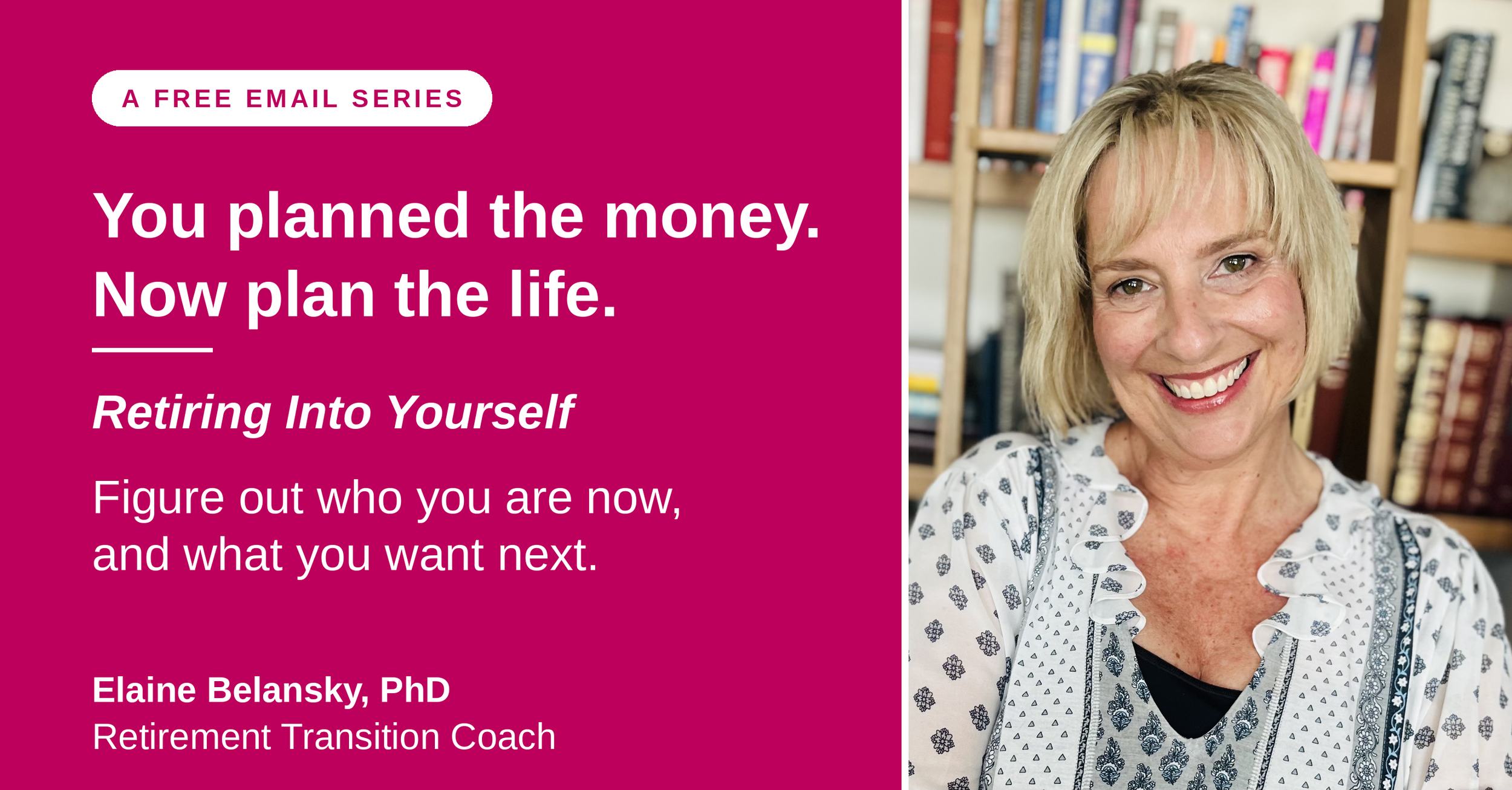
Five mornings of short reflections to help you find the parts of yourself your career crowded out, and one small daily practice to make your days feel more like yours. By the end of the week you'll have a clearer sense of what you want to carry forward and where to begin.
The woman who got crowded out
For most of my career I lost track of any part of me that wasn't a mom or a professor. That's the honest truth, and I don't think I'm unusual.
A big career and a full life have a way of swallowing every hour you have. The job, the house, aging parents, children for some of us, everyone's needs but your own. You tell yourself you'll come back to the rest of it. Then thirty years go by.
Nobody decides to give those things up. They slip out of sight while you're busy keeping everything else going.
And then the job ends, and someone asks what you want to do with all that time, and you come up empty. The space opens up and you draw a blank. That happens to the most capable women I know, and it happened to me — thirty years spent studying how people make real change, and I still couldn't answer a simple question about my own week.
The oldest clues are the clearest
When my kids were in high school and spent every other week at their dad's, I had long stretches of time alone. I tried painting. I bought a canvas and some paint markers and worked at it night after night with 70s music going. I was in heaven.
I hadn't felt that since I was a girl. Thursdays were my favorite days in elementary school because we had art class. Do you remember the scented markers? Cherry, lemon, grape, cinnamon, licorice. At the time it was just a happy school morning. Looking back, it was a clue.
That's the part I want you to have. When you can't answer “what do I want my days to look like now?” you can almost always answer “what did I love at nine?” And the second question gets you further than you'd think.
What other women said
A few weeks ago, I asked the women in my free email series, Retiring Into Yourself, that exact question: what did your 9-year-old self love? The answers came in fast, and not one of them read like a goals worksheet.
One got lost in books under the covers with her Girl Scout flashlight, so bedtime didn't have to stop the story. She rode her bike around the lake and came home when the street lights went on. Another rode hers down the hill to the library, picked out her own books, then sat by the creek in her backyard doing absolutely nothing.
Several described being outside with no adult anywhere in sight. One played on the street with the neighborhood kids and only came in when she saw her dad's car turn the corner. Another loved the trampoline after dark and stargazing. A third read for hours under a crabapple tree, then ran a pretend classroom.
One woman and her friend climbed inside the enormous box her parents' new stereo came in, drew windows and curtains on the sides, and played house under a pepper tree until her mother found a black widow spider under one of the flaps. The same girl read her family's World Book Encyclopedia cover to cover on stars and planets, because she was going to be an astronaut. Unless she was going to be a veterinarian. She once brought home a small stuffed dog from a swap meet, one ear missing and the other chewed, because he needed someone to love him.
Four of them wrote to me about Barbie, which is what I did too. Mine juggled dates with Ken around her shifts at the hair salon and, occasionally, as a flight attendant, and one woman remembered her own Barbie as a flight attendant too. Another built elaborate Barbie houses in the basement with her sister, houses that stayed up for weeks. Her parents wouldn't buy the prefabricated kind, so the girls made their own, and one Christmas her grandparents built her one out of a huge box, painted, with curtains and carpets.
She wrote again the next day with one more line: it was all about our own dreams of our future selves.
What nobody said
Look at what isn't in any of those answers. Nobody named an achievement. Nobody’s nine-year-old wanted a title, a promotion, or a corner office. What came back was being absorbed in something, being outdoors, being trusted to disappear for a few hours, and having people around when she wanted them and not when she didn’t.
Those are the ingredients of a good week at sixty-five, too. But somewhere along the way they stopped counting as a good use of a day.
One more, because it shows what this exercise is for. A woman wrote that she’d always liked making up stories, and that she has written three books in her head. Her son keeps telling her to put them on paper. “Perhaps that’s my retirement calling,” she said.
She wasn’t looking for a plan. She answered a question about being nine and walked straight into one.
How to Find What You Enjoy in Retirement
Think about how an ordinary school week was built. There was time to learn something and time to move your body. There was music and art. There was recess, which was nothing but free time to explore, plus field trips, lunch with friends, and time on your own.
Someone designed that week to help a child thrive. It turns out to be a good starting point for designing a retirement, because it covers everything a person needs and it never once asks you to be impressive.
Most retirement planning starts with the question “what will I do?” This starts somewhere better: what kinds of things absorbed you, or felt like freedom, before anyone was grading you on them.
A 15-Minute Retirement Exercise: The School-Week Blueprint
Give yourself fifteen minutes and a piece of paper, maybe over your coffee. Think back to an ordinary school week from when you were nine or ten, and go through it block by block. Write down whatever comes, including the things that feel silly.
● Learning. What were you curious about before anyone graded it?
● Moving your body. What did you do that felt like play instead of exercise?
● Music and art. What did you make, or wish you could?
● Recess. Which part of the playground did you head for first?
● Friends and alone time. Which did you need more of, and what did each one give you?
Then read your list and mark the two or three memories that make you light up a little. Those are the ones to follow.
One more step, and it's the one that matters. Pick a single item from your list and put it in your calendar this week, in an actual time slot. Not the whole reinvention. One thing, once, with a day and a time attached. A woman who loved the library at nine can go get a library card on Thursday. A woman who read under the covers can put an hour aside on Sunday afternoon and treat it as a real plan.
How to read your own list
Each memory on your list is pointing at something you can still have. The trick is reading past the activity to what it gave you.
If you rode your bike for miles, the clue might be motion, or fresh air, or going somewhere under your own steam. That has a hundred adult versions, and only some of them involve a bike.
If you read under the covers with a flashlight, the clue might be an hour that belongs to nobody else, and the small thrill of taking it.
If you built whole worlds for your dolls, the clue might be making something up with nobody grading it.
Go back through your list and ask what each one gave you. That's the part that comes with you.
The part that's harder than it looks
The noticing is the easier half. I want to be honest with you about the other half.
You'll do this exercise, you'll get four or five things back that made you feel like yourself, and then Monday will come and your daughter will need something and the dishwasher will break and the list will slide into a drawer. You meant every word of it. A lifetime of putting yourself last simply has more momentum than one good afternoon, and that's true for me too.
This is where I spend most of my time with clients. The gap between knowing what you want and living it is a real gap, and it rarely closes on its own.
A First Step
If the exercise gave you three or four things that feel like you, and you still can’t see how they become an actual retirement, that’s the most common place women land. It’s a workable place to start from.
“You see things in me that I don’t fully see in myself. I left our conversation with so much more clarity.”
That's the part I can help with. A Retirement Clarity Session is 45 minutes on Zoom, $97, to say all of it out loud to someone who has no stake in what you decide.
A few days beforehand you fill out a short reflection, about fifteen minutes, based on Martin Seligman's research into what makes a life feel good. It shows you where your life feels full right now and where it feels thin, and it lets me build the conversation around your situation instead of a script. Afterward I send you written notes with your key insights and one concrete next step, specific enough to do this week. Women tell me they pull those notes back up weeks later, on the nights the doubt comes back.
Most women I talk to can already tell me what they'd like more of. The hard part is that it keeps getting bumped, for the grandkids, for the appointment, for whatever someone else needs first. Forty-five minutes won't undo decades of putting yourself last. What it can do is get one specific thing onto your calendar and get honest about what keeps knocking it off.
Frequently Asked Questions
-
Because it's the last stretch of your life when what you did with your time was driven by what you enjoyed rather than what was required. Career, caregiving, and obligation shape decades of adult choices, so “what do I want?” is hard to answer directly. “What did I love at nine?” is a question you can answer, and what comes back is usually the same handful of things you’d want in a good week now.
-
No, and you're in a large crowd. After decades of answering what other people needed, the question of what you want takes a while to come back online. Try coming at it sideways: a specific room in a specific house, a particular smell, what you did on a Saturday morning, where you went when you wanted to be left alone.
-
You're not trying to reproduce the activity. You're after the quality underneath it. If you loved sitting by a creek doing absolutely nothing, the clue might be unhurried time outdoors with nothing to accomplish. That has a hundred adult versions, and it's easier to arrange than you'd think.
-
Now. The research supports the larger idea behind this exercise. A 2024 Canadian study of 748 fully or partly retired adults found that both financial and lifestyle planning predicted feeling prepared for retirement — but only lifestyle planning predicted how satisfied people were once they got there. Doing this before your date gives you a running start. Women who are already a few years in get just as much from it, often more, because they’ve discovered that an open week doesn’t fill itself.
And if you’re still deciding whether you’re ready at all, that’s a separate question with its own answer: Should I Retire Yet? The Emotional Readiness Checklist No One Gives You.
-
Goals start from what you think you should accomplish. This exercise starts from what absorbed you before anyone was keeping score. Most women I work with don’t need another achievement; they need a week that feels like theirs. Those are different projects.
Related Posts to Keep Exploring
● You’ve Planned the Money. Have You Thought About the Life? 10 Questions for Retirement (The Identity Shift)
● The Retirement Schedule That Actually Works (Rhythm & Routine)
● What Is Retirement Coaching — And Do I Really Need It? (Retirement Lifestyle Planning)
Share This With a Friend
Know a woman who keeps saying she'll figure out what she wants once things settle down? Use the share buttons to send it her way. The nine-year-old question is easier to answer than “what do you want,” and it gets her to the same place.
Source
Hutchinson, S. L., & Ausman, C. (2024). Not just one long vacation: Revisiting the importance of lifestyle planning in the transition to retirement. Canadian Journal on Aging / La Revue canadienne du vieillissement, 43(3), 414–426. https://doi.org/10.1017/S0714980823000788
About Elaine
Elaine Belansky, PhD, is a retirement transition coach who helps thoughtful, accomplished women design a next chapter that feels intentional, meaningful, and fully their own.
After a 30-year university career in public health and education, Elaine now supports women navigating the identity shifts, emotional complexity, and loss of structure that often accompany retirement. Drawing on psychological research and lived experience, she guides clients through a structured process to clarify who they are becoming, design a weekly rhythm that supports energy and engagement, and choose ways to contribute that feel purposeful — not obligatory.
She is also a regular contributor to Sixty and Me, where she writes about the emotional and identity shifts women face in retirement.
Adapted from an article originally published on Sixty and Me.
