
You’ve Planned the Money. Have You Thought About the Life?
10 Questions for Retirement
You planned the finances. These questions help you plan the life.
By the time many women seriously consider retirement, the financial question is usually already answered.
They’ve run the numbers.
Met with advisors.
Checked the spreadsheets more than once—just to be sure nothing was missed.
And then comes the moment no one really prepares you for:
Wait. I can actually afford to retire?!
Followed closely by:
Why does this suddenly feel a little terrifying?
As one client recently told me, deciding whether to retire feels like standing at a ledge—looking out, trying to imagine what’s on the other side, and wondering what your days will actually look like once work no longer structures them.
You don’t need answers to these questions before you retire—or even right away. But knowing which questions deserve your attention can change how this transition unfolds.
Before retirement, there’s often a mix of anticipation and unease: What will I do all day? Will I be bored? Will I still matter? These pre retirement emotions don’t get talked about nearly enough.
After retirement, different feelings can surface—unexpected restlessness, guilt about wanting more, or the sense that something still feels undefined. These retirement emotions often surprise women who assumed that once work ended, everything would fall neatly into place.
And that’s why these questions matter—whether you’re preparing to retire or already there.
If you’re new here:
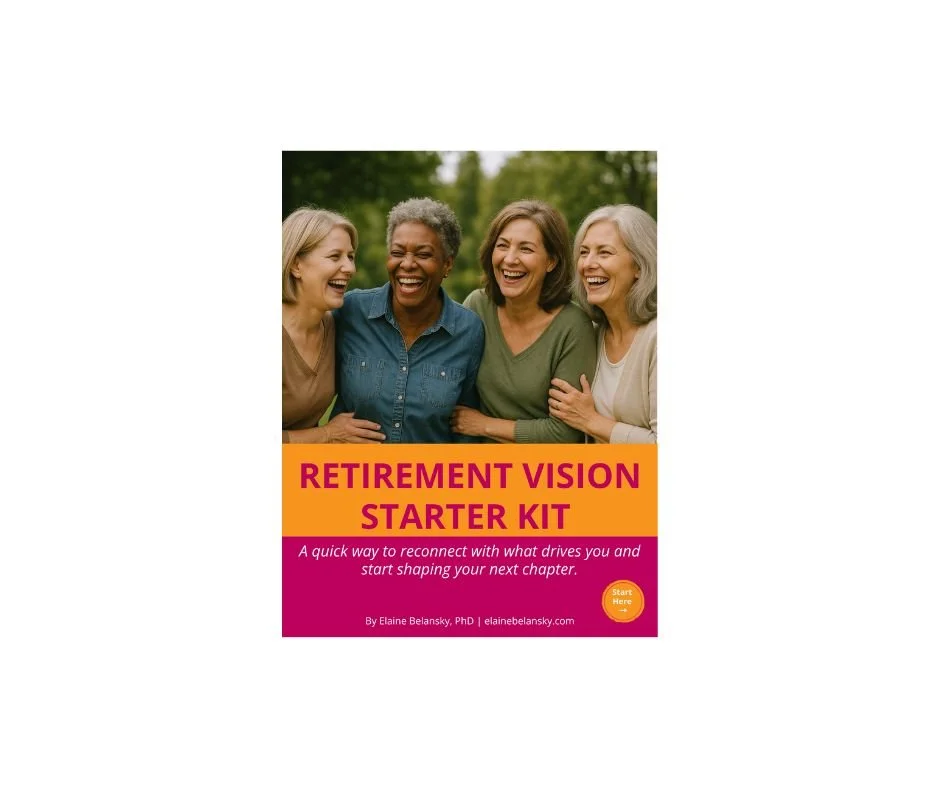
Free Starter Kit
Get clear on what you want your next chapter to look like—without pressure to have it all figured out.
Start with my free Retirement Vision Starter Kit — a quick, research-informed way to get clarity on what you want your next chapter to look like. It takes about 20 minutes.
If the identity shift is the hardest part, you may also like my free guide Who Am I Now?
1. If my days were no longer shaped by work, what do I actually want them to feel like?
Many women answer this question with activities: travel, volunteering, time with family.
But when I ask clients how they want their days to feel, they often pause.
Calm?
Energized?
Curious?
Grounded?
Connected?
It’s easy to fill your days and still feel oddly dissatisfied. Feelings—not activities—are what shape whether retirement actually feels good.
2. Once work is no longer the anchor, where will my sense of purpose come from?
When I was six months away from retirement and my anxiety started getting louder, I realized something important about myself: I was going to need a sense of purpose sooner rather than later.
For me, that meant getting certified as a life coach and starting to work with clients part time. Some people say, “So you’re not really retired.” I see it differently.
I’m retired on my own terms.
Purpose doesn’t have to look the same for everyone—but it does need to be intentional.
If this question feels heavy or confusing, you may find reassurance in The Secret to Finding Purpose in Retirement? Start Smaller Than You Think, which explores purpose without pressure or reinvention.
3. When work-based relationships fade, who will really be part of my day-to-day life?
This is the question many of my clients underestimate.
Without the built-in social structure of work, connection doesn’t just happen—it takes intention. Many women are surprised by how quickly work relationships fade, especially if they retire before friends or colleagues do.
I hear this most often when women talk about feeling disconnected during the week, missing casual conversation, or realizing that their adult children—busy with their own lives—aren’t as available as they once were.
Some clients are intentionally building new rhythms: joining women’s organizations, reconnecting with former colleagues in smaller groups, or saying yes to social invitations they might once have declined.
Almost all say the same thing: I wish I had thought about this sooner.
Connection doesn’t need to be constant—but it does need to be real.
If you want a deeper look at what can quietly get in the way of connection (and how to move through it), you may also appreciate The Hidden Emotional Barriers Women Face in the First Months of Retirement.
Want a simple 20-minute way to get clearer on what you want next? Grab the Retirement Vision Starter Kit here.
4. How much structure do I actually need to feel steady and grounded?
I used to think structure would limit my freedom. I’ve learned the opposite is true.
Many of my clients—and I include myself here—need some structure to feel steady. Not a schedule that feels like work, but a rhythm that helps the day unfold.
For me, mornings are an important time to ground myself. I read, journal, and sketch a loose plan for the day around what keeps me centered: movement, connection, something creative, and writing.
I’m still refining the blend. And I expect it will keep changing.
If you’ve ever thought, Shouldn’t I be enjoying all this quiet more than I am?, you may relate to Peace and Quiet Sounded Perfect—Until I Had Too Much of It in Retirement.
5. What parts of me have been waiting for more space—and are starting to speak up now?
This question often opens a door women didn’t realize was closed.
For many, long-deferred parts—creativity, rest, curiosity, pleasure—start asking for attention once work steps back.
Ignoring them rarely brings peace.
Listening often does.
6. How will I protect my energy without feeling selfish or guilty?
Until women learn to protect their energy, resentment can quietly build.
One client longs for peaceful mornings—reading the newspaper with a cup of coffee. Instead, she starts each day texting friends who might need her. By noon, she’s depleted and frustrated, yet feels guilty imagining any other way.
Energy management isn’t selfish.
It’s foundational.
7. If I’m honest, what am I afraid might happen if I slow down?
This question is quieter—but deeply revealing.
Underneath concerns about staying busy, I often hear deeper fears about aging, health, relevance, and mortality. Retirement makes time feel more finite.
Naming that fear reduces its power.
8. In this chapter, what does contribution look like for me now?
Many women worry that without a meaningful project, they’ll lose respect—from friends, family, or society at large.
For some women, contribution looks like mentoring, consulting selectively, or using hard-earned expertise in ways that feel meaningful—but not consuming.
Will people still find me interesting?
Will my children respect me?
Will I still matter?
Contribution doesn’t have to mean overcommitting or turning retirement into an unpaid job. It can be lighter, more intentional, and still deeply meaningful.
9. What would make me feel genuinely proud of how I’m living this season of my life?
Not proud in an achievement-driven way—but proud in an integrity-based one.
This is also where legacy quietly enters the picture.
Retirement offers a chance to model something different—for our children and for the women coming behind us. To show that it’s possible to prioritize yourself, set boundaries, and live a life that reflects who you are now.
Living that example can soften guilt—and replace it with pride.
If you’ve been feeling that identity wobble—like you’re not quite sure who you are without the role you held for decades—you might appreciate I Thought I Knew Who I Was — Until Retirement Made Me Rethink It.
10. How do I actually check in with myself—and hear what I’m wanting in this chapter?
A client recently admitted that at 70, she had no idea what helped her feel grounded. Journaling? Walking? Meditation? Prayer?
She wasn’t sure.
So rather than forcing an answer, we focused on helping her learn how to check in with herself—experimenting with different ways of slowing down and noticing what brought clarity or ease.
That’s often how insight emerges in retirement: not all at once, but by paying attention to what you feel drawn toward when you finally give yourself the space to listen.
A Small Experiment to Try This Week:
For the next five days, try this:
At the end of each day, write down one word that describes how the day felt.
Not what you did—just how it felt.
After five days, look at the words and ask yourself:
Do these feelings match what I want more of in this chapter?
There’s nothing to fix here.
This is simply about noticing. That’s often where clarity begins.
If You’re Wondering What Your Answers Mean:
I tend to see three patterns:
Some women feel clear and energized.
Some feel scattered or unmoored.
Some feel stuck—financially ready, but psychologically unsure about what comes next.
What matters is not postponing this kind of reflection. When women delay it, they often find themselves repeating old patterns—overgiving, staying small, or putting their own needs last.
This is especially common for high-capability women who are used to being competent—and suddenly don’t feel that way in this transition.
If you’re in that “stuck or anxious” camp, that’s exactly what my Retirement Clarity Session is designed for—turning all this thinking into one grounded next step.
If You Want to Keep Exploring This:
If these questions stirred something and you’d like help turning reflection into clarity, I created a free resource to support that process:
👉 The Retirement Vision Starter Kit
A free research-informed, practical way to explore what you want your next chapter to look like—without pressure to have everything figured out.
Start with the Starter Kit first. Then, if you want to see how this all fits into a clear, supportive process, read: Unsure What Your Life Will Look Like in Retirement? Why That Happens—and the Steps That Help You Get Clear
Related posts to keep exploring:
I Thought I Knew Who I Was — Until Retirement Made Me Rethink It
The Hidden Emotional Barriers Women Face in the First Months of Retirement
Share this with a friend: If you know a woman who’s financially ready to retire—but still feels unsure about the life part—use the share buttons below to send this post to her.
Final Thought:
You’ve spent decades showing up, contributing, and taking care of others.
This chapter deserves thoughtful attention too—not just financially, but emotionally and intentionally.
The quality of this chapter is shaped by the questions you give your attention to.
If you want a simple place to start, the Retirement Vision Starter Kit is here.
About Elaine
Elaine Belansky, PhD, is a retirement transition coach who helps thoughtful, accomplished women design a next chapter that feels intentional, meaningful, and fully their own.
After a 30-year university career in public health and education, Elaine now supports women navigating the identity shifts, emotional complexity, and loss of structure that often accompany retirement. Drawing on psychological research and lived experience, she guides clients through a structured process to clarify who they are becoming, design a weekly rhythm that supports energy and engagement, and choose ways to contribute that feel purposeful — not obligatory.
Her work helps women move from feeling unmoored or uncertain to feeling grounded, energized, and confident about the life they’re building now.
